
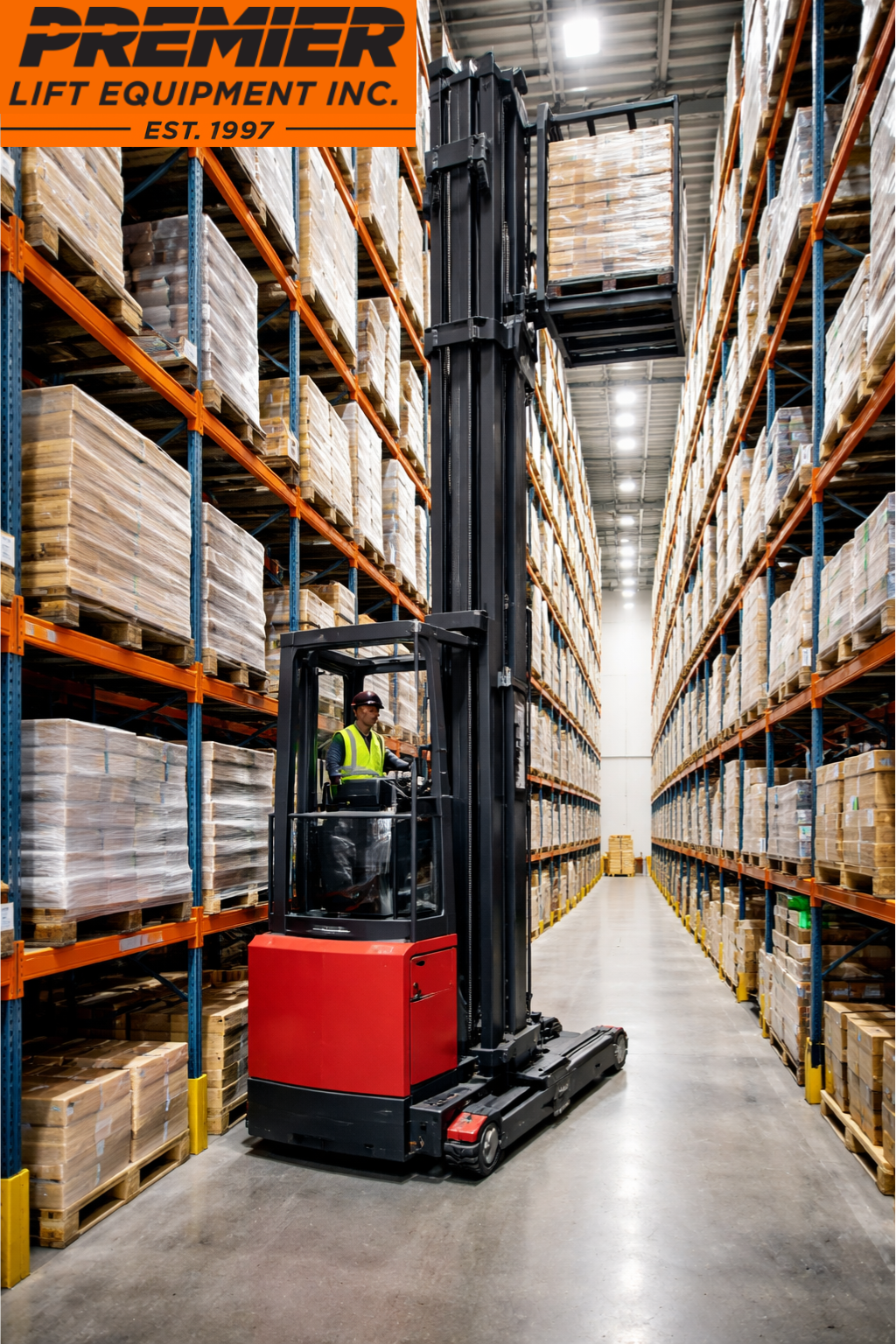
Warehouse space is expensive—and getting more of it isn’t always an option. As inventory levels grow and buildings reach capacity, many operations face the same question: how do we store more product without expanding our footprint?
For many facilities, the answer lies in Very Narrow Aisle (VNA) equipment. Designed to operate in extremely tight aisle widths and at greater heights, VNA forklifts allow warehouses to significantly increase storage density while improving space utilization.
When implemented correctly, VNA solutions can unlock capacity you didn’t realize you already had.
What Is VNA Equipment?
VNA (Very Narrow Aisle) equipment refers to specialized forklifts—such as turret trucks and guided VNA trucks—engineered to operate in aisles much narrower than traditional forklifts or reach trucks.
Key characteristics include:
- Operation in aisles as narrow as 5–6 feet
- High lift capabilities, often exceeding 40 feet
- Rotating or articulating forks for precise load placement
- Compatibility with wire or rail guidance systems
These features allow warehouses to reduce aisle space and dedicate more square footage to racking and storage.
How VNA Equipment Increases Storage Density
Narrower Aisles Create More Storage Space
Aisles consume a large percentage of warehouse floor space. By reducing aisle widths, VNA equipment allows facilities to add additional rows of racking within the same building footprint.
In many cases, converting from standard aisles to VNA aisles can result in significant increases in pallet positions, all without expanding the facility.
Maximizing Vertical Cube Utilization
VNA forklifts are designed to safely handle loads at extreme heights. This allows warehouses to take full advantage of high-bay racking systems and vertical storage opportunities.
By increasing lift height and precision, VNA equipment helps:
- Improve vertical space utilization
- Reduce the need for off-site storage
- Support higher-density racking designs
The result is better use of both floor space and air space.
Avoiding Costly Facility Expansion
Building expansions are expensive, disruptive, and often unnecessary. VNA conversions offer an alternative that typically delivers a faster return on investment.
By reconfiguring racking and aisle layouts, many operations achieve substantial storage gains without the costs and downtime associated with construction or relocation.
This makes VNA particularly attractive for facilities in space-constrained or high-cost locations.
Precision Through Guidance Systems
Most VNA systems use wire guidance or rail guidance to keep the truck perfectly centered within the aisle.
These systems:
- Enable extremely narrow aisle widths
- Reduce rack and product damage
- Improve operator confidence at height
- Support consistent, repeatable load handling
Guidance also reduces operator fatigue and enhances safety in high-lift environments.
When VNA Equipment Makes Sense
VNA equipment is best suited for operations that:
- Manage high pallet volumes
- Operate in high-bay warehouses
- Require maximum storage density
- Handle consistent pallet sizes and weights
- Want to scale capacity without expanding their building
Common applications include distribution centers, retail fulfillment operations, food and beverage storage, and manufacturing warehouses.
Key Considerations Before Switching to VNA
While VNA offers significant benefits, successful implementation requires careful planning.
Important factors to evaluate include:
- Floor flatness and condition
- Racking design and load ratings
- Guidance system requirements
- Operator training needs
- Upfront investment and long-term ROI
A professional site assessment helps ensure VNA equipment delivers measurable improvements without creating operational challenges.
How Premier Lift Helps With VNA Solutions
At Premier Lift, we take a consultative approach to VNA projects.
Our team can:
- Assess your current warehouse layout
- Determine whether VNA is a good fit
- Recommend the appropriate equipment and guidance system
- Support layout changes, training, and ongoing service
We focus on solutions that improve efficiency, safety, and long-term performance—not just equipment sales.
Conclusion
VNA equipment is one of the most effective ways to increase storage density and maximize existing warehouse space. When paired with the right layout and support, it allows operations to grow capacity, improve efficiency, and delay or eliminate the need for expansion.
If your facility is running out of space, VNA may be the solution that helps you move forward.
If you’d like help evaluating whether VNA equipment is right for your operation, our team is here to help.
👉 Book a service to keep your fleet compliant!