
🕒 Updated November 2, 2025
When it comes to warehouse design, there's one question that shows up on almost every job site, napkin sketch, or boardroom whiteboard:
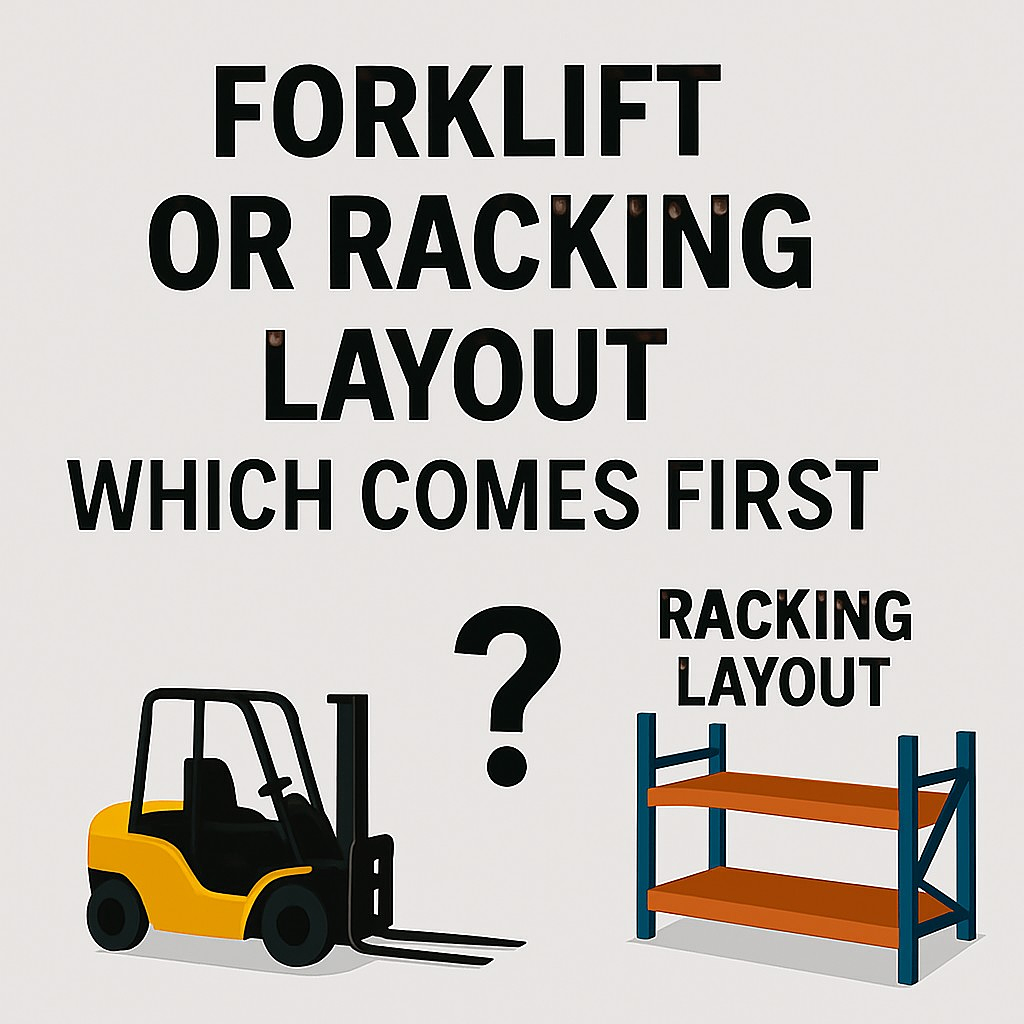
Do we design the racking layout first—or choose the forklifts first?
It’s a bit like asking: Should the roads be built for the cars, or should we design cars for the roads?
If you’ve been in the warehousing world long enough, you already know the truth:
You can’t answer that question in isolation. The best warehouses are designed backwards—from the inside out, and from the top down.
Let’s unpack what that actually means—and how you can avoid the costly mistake of solving the wrong problem first.
The Real Starting Point: Product, Process & Flow
Before we talk steel racking or rolling tires, we need to talk about what’s moving, how fast, and how often.
- Are you storing pallets, cartons, or long material?
- Are items in and out every hour, or sitting for weeks?
- Are you picking full pallets or individual items?
Because here’s the thing—racking and forklifts are just tools. And like any tool, their value depends on how well they support the job you’re actually doing.
If your warehouse is a living organism, the racking is the skeleton and the forklifts are the muscles. But it’s the product and the flow that give it a heartbeat.
Racking Layout: The Framework That Shapes Everything
Most warehouse designs begin by defining how to use the cubic volume—not just square footage.
That means:
- Determining rack height based on ceiling clearance and sprinkler codes
- Mapping out aisle widths based on load handling needs
- Choosing rack types (selective, drive-in, push-back, etc.) that match product movement
But here’s the trap: if you overdesign the racking before knowing how it’s going to be serviced, you might be stuck with a layout that looks great on paper—and fails in real life.
Forklifts: The Unsung Architects of Aisle Width
A forklift’s turning radius, mast height, and load capacity all place real-world limits on your warehouse layout.
Choose the wrong one and you may end up with:
- Aisles too tight for maneuvering
- Racking heights unreachable
- Operators taking twice as long to do the job
Here’s where it gets interesting:
If you already own forklifts, your layout must adapt. If you’re starting fresh, your forklift choice should be based on the racking strategy.
So again, what comes first? Neither. What comes first is the conversation.
The Premier Answer: Design from the Ground Up—Not in Silos
At Premier Lift Equipment, we’ve seen too many companies back themselves into a corner:
- A brand-new reach truck that can’t reach the top beam
- A narrow aisle layout designed for standard counterbalance trucks
- A racking system so dense it slows down throughput
That’s why we approach every project with a system mindset—not just selling a truck or a rack, but solving for space, safety, and scalability together.
What You Can Do Right Now
If you're planning or rethinking your warehouse, here’s your cheat sheet:
- Start with the product and flow—What are you moving, and how often?
- Map out your volume—How high can you go? How wide can you spread?
- Evaluate your racking options—Selectivity, density, and speed
- Match the forklift to the layout—Aisle width, lift height, maneuverability
- Pressure test everything—CAD layouts, real-world walk-throughs, workflow simulations
And if you’re not sure where to start?
Call us before you build. Before you buy. Before you compromise.
Because we don’t just move lift trucks—we move businesses forward.
Final Thought: It’s Not About First. It’s About Fit.
The best warehouses don’t prioritize one over the other—they design with intention. Forklifts and racking are not competing priorities. They are two parts of the same system. And when they work in harmony, your business flows better, moves faster, and grows easier.
✅ Want a no-pressure layout consultation?
We offer complimentary assessments where we review your current space, workflow, and goals—and help you build a racking and forklift plan that actually fits your business.