
Choosing the Right Mast Isn’t Technical — It’s a Commercial Decision
Most companies compare 2‑stage vs 3‑stage masts as if it’s just about lift height. It isn’t.
Your mast choice determines:
- Whether the unit fits through your dock doors
- Whether it clears your sprinkler lines
- Whether it reaches your top rack
- Whether your operator can see
- Whether your capacity derates below what your pallet actually weighs
- Whether the forklift is even usable in your building
This is why mast selection is one of the highest‑impact commercial decisions you can make when buying a forklift.
At Premier Lift Equipment, we see this every day across reach trucks, counterbalance forklifts, order pickers, and swing‑mast units. The wrong mast can cost you thousands in lost productivity — the right one unlocks your building’s full storage potential.
How Mast Design Affects Your Equipment Category
Different equipment categories rely on mast stages differently:
Reach Trucks (Raymond, Crown, Toyota)
- Almost always 3‑stage
- Designed for high lift in narrow aisles
- Free‑lift is mandatory under sprinkler lines
- Visibility and stability matter at 25–35 ft
Order Pickers
- Operator goes up with the load
- 3‑stage masts dominate
- Stability + visibility = safety
- MLITSD inspections focus heavily on mast condition
Electric Counterbalance (Toyota, UniCarriers, Heli)
- 2‑stage or 3‑stage depending on ceiling height
- 2‑stage = better visibility
- 3‑stage = better collapsed height
Swing‑Mast / VNA (Drexel, Bendi)
- 3‑stage is standard
- Collapsed height is critical for VNA tunnels
- Capacity derating must be checked at every lift height
This is why mast choice must be tied directly to your category page, not treated as a standalone decision.
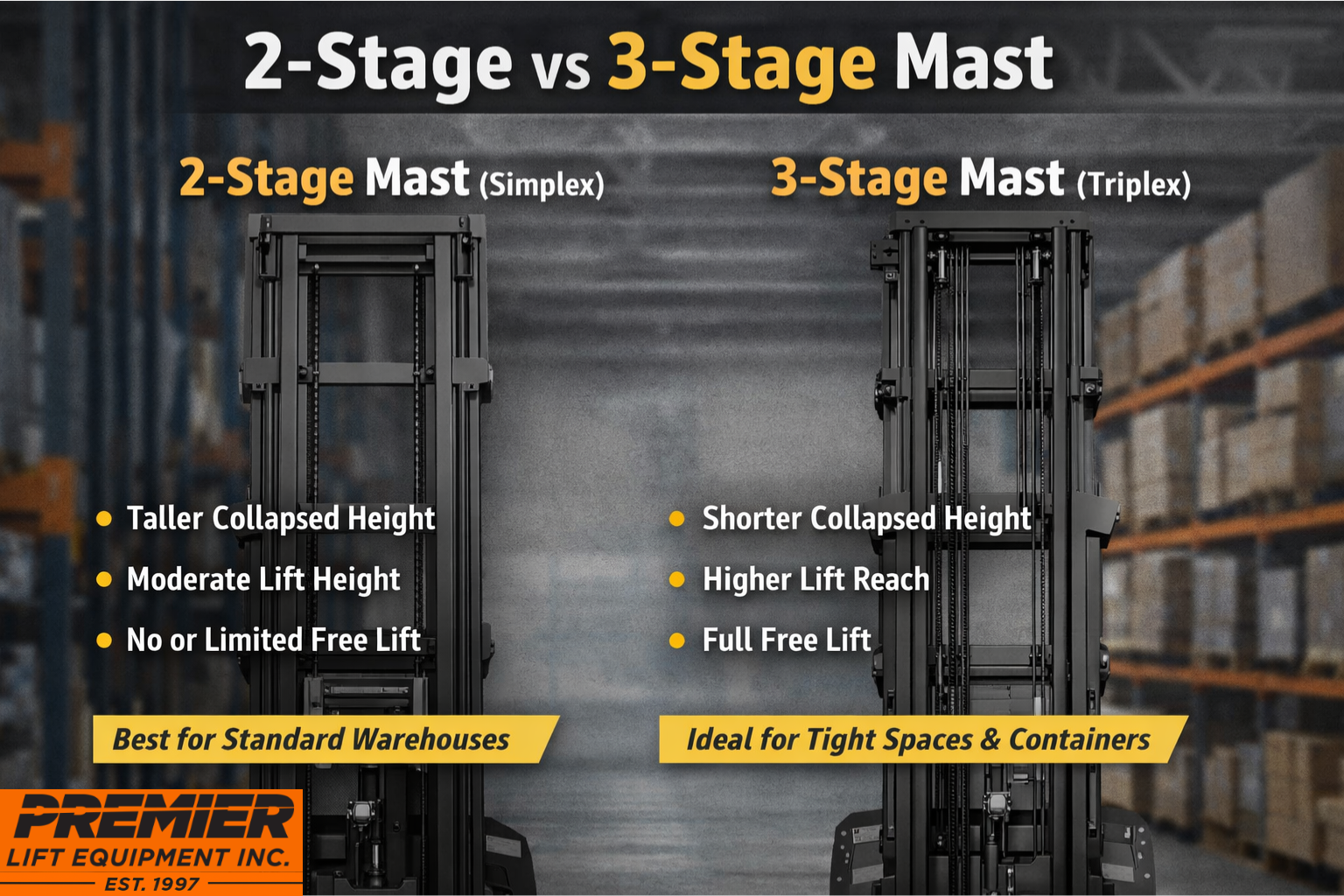
2‑Stage Mast (Simplex / Duplex)
A 2‑stage mast has two telescoping sections.
It’s taller when collapsed, but simpler and more visible.
Best for:
- Outdoor yards
- High‑clearance warehouses
- Standard door heights
- Counterbalance forklifts
- Environments where visibility matters more than collapsed height
Advantages:
- Fewer moving parts
- Lower cost
- Better operator sightlines
- Strong stability at mid‑range lift heights
Limitations:
- Taller collapsed height
- Not ideal for trailers, containers, or low beams
- Free‑lift is optional, not standard
3‑Stage Mast (Triplex)
A 3‑stage mast has three telescoping sections.
It reaches higher while staying shorter when collapsed.
Best for:
- Narrow‑aisle warehouses
- High racking
- Facilities with low beams or sprinkler lines
- Trailers, containers, mezzanines
- Reach trucks, order pickers, swing‑mast units
Advantages:
- Higher lift
- Lower collapsed height
- Free‑lift is standard
- Works in tight overhead environments
Limitations:
- Slightly reduced visibility
- Higher cost
- More complex maintenance
Why Free‑Lift Matters (Compliance + Safety)
Free‑lift allows the forks to rise without raising the mast.
This is critical when working under:
- Sprinkler lines
- Mezzanines
- Dock doors
- Trailer roofs
- Low beams
Without free‑lift, the mast extends immediately — a major MLITSD compliance risk and a common cause of overhead strikes.
Free Facility Clearance & Mast Analysis
Unsure which mast configuration fits your building? Fill out your building specs below, and our Brampton team will personally review your layout and email you a pre-filtered equipment recommendation within 24 hours.
- Question 1: Lowest Overhead Obstruction (e.g., Doorway, Sprinkler, Mezzanine)
- Question 2: Maximum Rack / Lift Height Required
- Question 3: Work Environment (Options: Standard Warehouse/Racking, Trailer Loading, Narrow Aisle/VNA, Outdoor Yard)
Request Free 24-Hour Mast Analysis
Need Help Balancing Mast Height vs. Budget? Whether you need a low collapsed height for tight dock doors or a high-reaching triple mast for narrow-aisle racking, balancing specifications with capital cost is critical. Explore our tiered inventory starting with our Budget Inventory
Capacity, Stability & Compliance (CSA B335‑25)
As lift height increases, stability decreases.
As mast stages increase, capacity derates.
Under CSA B335‑25, operators must:
- Use the actual capacity from the data plate
- Understand derating at height
- Account for attachments
- Confirm mast configuration matches the plate
This is where many facilities fail audits.
A 5,000 lb forklift with a 3‑stage mast may only be rated for 3,200–3,800 lb at full height depending on the model.
Never assume capacity — verify it.
Need a Facility Compliance & Safety Review? Avoid failed facility audits and unexpected capacity derating. Let our Brampton team conduct a complimentary review of your equipment layout, mast specifications, and safety readiness to ensure full alignment with CSA B335 standards.
How to Choose the Right Mast (Commercial Framework)
Choose a 2‑Stage Mast If:
- You have high ceilings
- You operate mostly outdoors
- Visibility is a priority
- You want lower maintenance
- You don’t need extreme lift heights
Choose a 3‑Stage Mast If:
- You have low beams or sprinkler lines
- You load trailers or containers
- You need high racking
- You run reach trucks or order pickers
- You need free‑lift
The right mast is the one that fits your building, not the one that looks best on paper.
Need an expert pair of eyes on your building specs? Unsure if your low beams or sprinkler lines require a custom triple or quad mast configuration? Let our Brampton team verify your facility measurements before ordering.Contact our team for a fast facility review.
FAQ — Real‑World Mast Selection Mistakes (What Buyers Miss Before Ordering)
Q: Why do forklifts with the same mast height behave differently at full lift?
A: Mast stiffness, rail thickness, and carriage design vary by manufacturer. Two forklifts with a “189-inch triple mast” can feel completely different at height because of deflection and sway characteristics.
Q: Does collapsed height matter more than lift height?
A: In most warehouses, yes. Collapsed height determines whether the forklift can enter trailers, pass under 82–84 inch doorways, or clear low beams. Many buyers focus on lift height and forget the building’s lowest obstruction.
Q: Why do operators prefer 2‑stage masts even when 3‑stage is available?
A: Visibility. A 2‑stage mast has fewer rails and cross‑members, giving operators a clearer line of sight when traveling or staging pallets. This reduces product damage and improves aisle confidence.
Q: Does free‑lift change how a forklift behaves in tight spaces?
A: Yes. Free‑lift allows the forks to rise without extending the mast, which prevents overhead strikes under mezzanines, dock doors, and sprinkler lines. Warehouses with mixed ceiling heights should treat free‑lift as mandatory.
Q: Why does capacity drop so much at height on 3‑stage masts?
A: More mast sections = more weight + more forward load shift. At full height, the load center effectively moves forward, reducing stability. This is why a 5,000 lb forklift may only be rated for 3,200–3,800 lb at full lift.
Looking for equipment with the right mast configuration? Browse our current inventory to compare certified units across reach trucks, order pickers, and counterbalance forklifts.
More Faq Questions
What’s the biggest advantage of a 3‑stage mast?
Higher lift with a lower collapsed height — essential for warehouses with beams, sprinklers, or mezzanines.
When is a 2‑stage mast better?
When visibility, simplicity, and lower maintenance matter more than collapsed height.
Which equipment categories rely on 3‑stage masts?
Reach trucks, order pickers, and swing‑mast units — all designed for high lift in tight spaces.
Does mast choice affect capacity?
Yes. More stages = more derating. Always check the data plate to stay CSA‑compliant.
Explore Triple-Mast, Two-Mast & Specialized Categories
If you are unsure which mast configuration matches your facility's ceiling height, low beams, or sprinkler lines, Premier Lift can help you determine the correct setup and supply equipment matching your requirements:
- Reach Trucks — Explore certified high‑reach forklifts designed for narrow‑aisle warehouse storage.
- Order Pickers — Browse CSA‑certified order pickers built for elevated picking and vertical travel.
- Crown RR5225‑45— See a fully reconditioned reach truck with a 3‑stage mast and excellent visibility.
- Electric Counterbalance Units (2-Stage & 3-Stage)— Toyota & Raymond stand‑up and sit‑down units .
- Swing‑Mast Forklifts — Drexel & Bendi VNA solutions
Ready to Match a Mast to Your Inventory? Browse our fully reconditioned, CSA-compliant units categorized by mast type and clearance profile, or let us build a custom package for your facility.
✅ Call Our Brampton Team Directly