
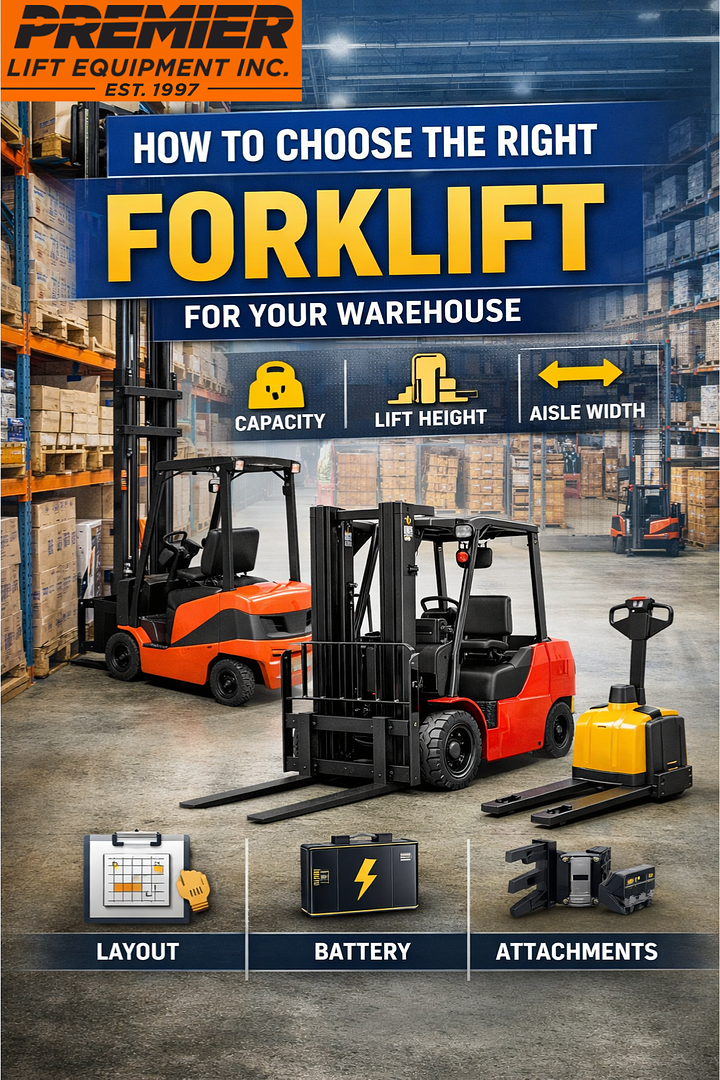
Choosing the right forklift for your warehouse is about more than just lifting capacity or price. The right truck improves safety, maximizes productivity, and fits seamlessly into your building layout. The wrong one can cause clearance issues, slow operations, increase maintenance costs, and create safety risks.
This guide walks through the key factors to consider so you can confidently choose a forklift that actually works for your warehouse—not against it.
Start With Racking Before You Even Think About Forklifts
One of the biggest mistakes I see is companies choosing a forklift before they understand how their warehouse will actually be laid out. The smartest move you can make is bringing in an experienced racking company before you even commit to a lease.
A good racking partner will sit down with you, understand your goals — expanding, downsizing, SKU growth, pallet sizes, weights — and help you shortlist buildings that actually fit your operation.
Once the building is confirmed, CAD drawings maximize every square foot. Only then do you know what forklift options make sense. The building and racking design choose the forklift — not the other way around.
Start With Your Warehouse Layout
Your building dictates more than you might expect. Before looking at forklift models, evaluate:
- Aisle widths
- Racking height
- Door and dock clearances
- Ceiling height, sprinklers, and lighting
Tight aisles or low doors may immediately rule out certain forklift types or mast configurations. A forklift that fits on paper but not in practice will slow down every movement.
What I Look for the Moment I Walk Into a Warehouse
When I walk into a warehouse for the first time, I’m immediately scanning for the things most people overlook:
- Ceiling height
- Door and tunnel heights
- Any restricted or low-clearance areas
- Aisle spacing and turning room
- How operators are currently maneuvering
- These details tell me instantly what equipment will work and what won’t. A forklift that looks perfect on paper can become useless if it can’t clear a doorway or turn in a tight aisle.
Choose the Right Forklift Type
Most warehouses rely on electric forklifts, but the exact style matters.
Counterbalance forklifts are the most common choice for standard aisles and dock work. They’re versatile and easy for operators to use.
Narrow aisle trucks—such as reach trucks or order pickers—are designed for facilities trying to maximize racking density. These require tighter tolerances but dramatically increase storage capacity.
Pallet trucks and walkies are ideal for dock work, short-distance transport, and staging pallets rather than high stacking.
Choosing the right class of forklift depends on how goods move through your warehouse, not just how high they need to be stored.
Get Forklift Capacity Right
Forklift capacity isn’t just about the weight on the pallet. Capacity is affected by:
- Load weight and size
- Load center
- Lift height
- Attachments
A forklift rated for 5,000 lbs at ground level may not safely lift that same load to the top rack. Under-sizing a forklift creates safety risks, while oversizing increases costs unnecessarily. Always size for your heaviest, highest, and most awkward load.
The One Thing I Wish Every Warehouse Customer Understood
If there’s one thing I wish every customer understood, it’s this:
Your building layout determines your forklift — not the other way around.
I’ve seen too many companies buy equipment first and then discover it doesn’t fit their racking, their tunnels, or their turning radius. A forklift that “should work” becomes a daily headache if the warehouse wasn’t planned around it.
Select the Correct Mast Configuration
The mast determines how high you can lift and how much overhead clearance you need.
- 2-stage masts work well in open warehouses with standard door heights and lower racking.
- 3-stage (triplex) masts are better for low doors, trailer loading, and high racking due to their shorter lowered height and built-in free lift.
If your operators regularly load trailers or work under low obstructions, mast choice is critical.
Consider Aisle Width and Maneuverability
Turning radius, truck length, and steering type all affect how efficiently a forklift moves through your warehouse.
Three-wheel electric forklifts offer tighter turning in confined spaces, while four-wheel trucks provide added stability for heavier loads. Narrow aisle operations may require specialized equipment altogether.
A forklift that constantly needs extra maneuvers costs time and increases collision risk.
Think About Battery and Charging Strategy
Battery selection directly affects uptime.
Lead-acid batteries require watering, ventilation, and scheduled charging. Lithium-ion batteries offer faster charging and less maintenance but at a higher upfront cost.
You’ll also need to consider:
- Number of shifts per day
- Opportunity charging vs battery swapping
- Space for charging stations
A poor charging setup can cause more downtime than the wrong forklift model.
Don’t Forget Attachments
Attachments like side shifters, fork positioners, or clamps improve efficiency—but they also:
- Add weight
- Reduce forklift capacity
- Change load stability
Any attachment requires updated capacity ratings and operator training. Choose attachments that truly improve workflow, not just convenience.
Operator Comfort and Safety Matter
Comfort impacts productivity and safety. Look for:
- Clear visibility through the mast
- Ergonomic controls
- Smooth acceleration and braking
- Adequate lighting and warning systems
A forklift that’s uncomfortable or hard to see from leads to fatigue, errors, and incidents.
CSA & MLITSD Compliance: Why Layout and Equipment Must Match
Under CSA B335‑25 and MLITSD 2026 guidelines, your forklift must match the physical constraints of your warehouse — aisle width, turning radius, mast height, and load handling requirements.
This affects:
- Safe travel paths
- Visibility and blind‑corner risk
- Stability at height
- Dock and tunnel clearance
- Legal operating limits
- Choosing the wrong forklift for your layout isn’t just inconvenient — it can create compliance issues and safety risks.
Plan for Growth, Not Just Today
One of the most common mistakes is choosing a forklift that only meets current needs. Consider:
- Future racking changes
- Increases in throughput
- New product sizes or weights
- Additional attachments
Buying slightly more capability now is often cheaper than replacing equipment later.
The right warehouse forklift balances capacity, maneuverability, lift height, and efficiency—while fitting your building and workflow. There’s no universal “best forklift,” only the best one for your operation.
At Premier Lift Equipment, we help warehouse operators evaluate layout, load requirements, and future plans to recommend forklifts that are safe, compliant, and built for real-world use.
Explore Warehouse‑Ready Forklift Options
- VNA Turret Trucks — Maximum storage density and ultra‑narrow aisle performance
- Reach Trucks — Designed for high racking and narrow aisles
- Dockstockers / Dock Forklifts — Built for fast dock work and tight turns
- CSA‑Certified Electric Forklifts — Fully inspected and warehouse‑ready
The Premier Strategy™ Framework Operating in the GTA means navigating strict CSA and Ministry of Labour audit requirements. Depending on your facility’s capital and compliance timeline, Premier Lift Equipment offers two tailored procurement paths:
- Explore Premier Certified™ Units: Fully reconditioned, CSA-aligned, and audit-ready equipment designed to eliminate compliance gaps and beat OEM wait times.
- Explore Premier Budget™ Options: Capital-efficient, unbundled chassis solutions tailored for operations looking for reliable mechanical performance without paying for redundant overhead. Need help selecting the right tier for your floor? Call our Brampton yard directly at 99 West Drive.
Choosing the right forklift starts with choosing the right layout.
👉 Schedule a warehouse forklift assessment
👉 Talk to our team about the right forklift for your layout and workflow
👉 Browse our CSA-certified forklifts ready for warehouse use