
Choosing the wrong forklift battery system doesn’t just cost you money — it creates downtime, shortens equipment life, and quietly reduces productivity.
Voltage isn’t just a spec on a data plate. It determines performance, runtime, charger requirements, and long-term operating costs.
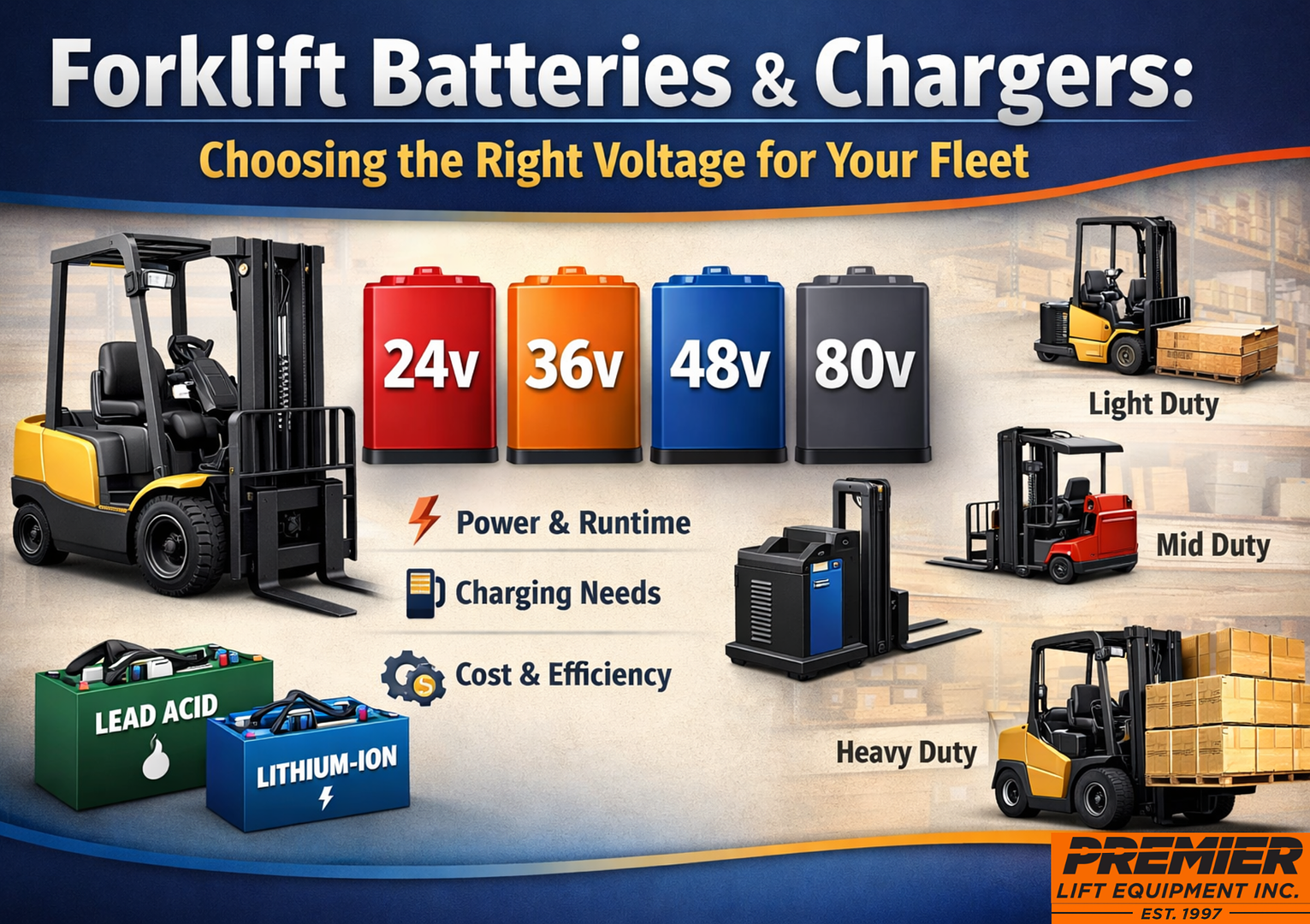
Let’s break down how 24V, 36V, 48V, and 80V systems differ — and how to choose the right one for your fleet.
If you’re evaluating battery voltage options for warehouse equipment, it helps to understand how different power systems pair with specific forklift types. Most 24V, 36V, 48V, and 80V setups are found on electric reach trucks and narrow‑aisle equipment, which rely heavily on battery performance for lift speed and runtime. You can explore our full range of certified reach trucks here.
Why Voltage Matters More Than You Think
Voltage affects:
- Power output
- Travel and lift speed
- Duty cycle capability
- Battery weight
- Charger size and cost
- Infrastructure requirements
Higher voltage generally means more power and better performance under heavy loads — but it also means higher acquisition cost.
The mistake many operations make? Choosing based on price instead of application.
24V Systems
Best for: Light-duty, small equipment
Common in:
- Walkies
- Pallet jacks
- Small stackers
Pros:
- Lower upfront cost
- Lighter battery weight
- Minimal charging infrastructure
Cons:
- Limited runtime
- Not suited for high-throughput environments
If your trucks are moving light loads and not running full shifts, 24V works. Otherwise, it becomes a bottleneck fast.
For facilities that rely on operator‑up picking or frequent vertical travel, battery voltage plays an even bigger role. Order pickers depend heavily on consistent power delivery to maintain lift speed and platform stability throughout a shift. You can browse our full range of CSA‑certified order pickers here.
36V Systems
Best for: Mid-size reach trucks & order pickers
Common in:
- Single reach trucks
- Order pickers
- Light warehouse applications
Pros:
- Good balance of power and cost
- Moderate runtime
- Suitable for single-shift operations
Cons:
- May struggle in high-intensity, multi-shift environments
If you’re running standard warehouse operations without extreme lift heights or heavy loads, 36V is often the sweet spot.
48V Systems
Best for: High-performance warehouse forklifts
Common in:
- Larger reach trucks
- Turret trucks
- Counterbalanced electrics
Pros:
- Stronger lift and travel performance
- Longer runtime
- Handles heavier loads better
Cons:
- Higher battery and charger cost
- Heavier battery weight
For busy distribution centers, 48V often delivers the best return because performance gains outweigh the higher upfront cost.
80V Systems
Best for: Heavy-duty, high-capacity electric forklifts
Common in:
- Large sit-down electrics
- High-capacity counterbalance units
Pros:
- Maximum power output
- Strong acceleration and lift speed
- Ideal for multi-shift operations
Cons:
- Highest infrastructure cost
- Requires proper charging setup
- Larger, heavier battery packs
If you're replacing internal combustion units with electric alternatives, 80V is often the platform that makes it possible.
If you want to see how a properly matched battery system performs in a real electric counterbalance application, take a look at this refurbished Hyster J35XNT 36V unit. It’s a strong example of how voltage, amp‑hour capacity, and charger pairing directly affect lift speed, runtime, and daily productivity.
Choosing the right voltage isn’t just about matching a battery to a forklift — it’s about matching your power system to your actual workflow. Facilities with long travel distances, frequent lifting, or multi‑shift operations often see major gains by moving up in voltage, while smaller warehouses can reduce costs by staying within the 24V or 36V range. The key is understanding how voltage, amp‑hour capacity, and charger output work together to support your daily throughput.
Lead Acid vs Lithium-Ion: The Bigger Decision
Voltage is one factor — chemistry is the other.
Lead Acid
- Lower upfront cost
- Proven technology
- Requires watering & maintenance
- Longer charge times
Lithium-Ion
- Opportunity charging capable
- No watering
- Faster charging
- Higher upfront cost
Multi-shift operations increasingly justify lithium due to reduced downtime and labor savings.
Charger Selection: The Overlooked Factor
Your charger must match:
- Voltage
- Amp-hour rating
- Battery chemistry
Undersized chargers shorten battery life. Oversized chargers can cause overheating and damage.
For example:
- A 36V 750Ah battery requires a different charger output than a 36V 500Ah battery.
- Lithium chargers are not interchangeable with lead-acid systems.
Infrastructure planning matters just as much as battery selection.
Questions to Ask Before Choosing
- How many hours per shift do your trucks run?
- Single shift or multi-shift?
- Do you have space for battery changing?
- Is downtime currently costing you money?
- Are you planning to electrify more of your fleet?
Voltage selection should align with growth plans — not just today’s workload.
The Real Cost Equation
Lower voltage = lower upfront cost
Higher voltage = higher productivity
But productivity compounds.
If a higher voltage system saves 20 minutes per shift per truck, that’s hundreds of labor hours annually.
Choosing the right battery system is less about specs and more about operational math.
Most fleets don’t suffer from bad forklifts.
They suffer from mismatched power systems.
The right 24V, 36V, 48V, or 80V setup should:
- Support your workload
- Reduce downtime
- Extend equipment life
- Improve throughput
If you're unsure whether your current battery system is costing you performance, it’s worth reviewing. The gains are often bigger than expected.
👉 Talk to our team about which battery system will work best for your operation today!
👉 Schedule a site assessment prior to setting up your new operation now!
👉 Book a service for your battery now!
Frequently Asked Questions
Q: What voltage do most warehouse forklifts use?
Most warehouse equipment runs on 24V, 36V, or 48V systems. Reach trucks and order pickers commonly use 36V or 48V setups, while smaller pallet trucks typically run on 24V.
Q: When should a facility upgrade to an 80V system?
80V systems are ideal for high‑capacity electric forklifts that need strong lift performance, long travel distances, or multi‑shift operation. They deliver more torque and longer runtime compared to lower‑voltage systems.
Q: How do I know if my charger is properly matched to my battery?
Your charger must match the battery’s voltage and amp‑hour rating. An undersized charger increases downtime, while an oversized charger can shorten battery life. Always pair chargers and batteries based on manufacturer specifications.
Q: Do lithium‑ion batteries work with standard forklift chargers?
No. Lithium‑ion systems require chargers specifically designed for their chemistry and battery management systems. Using a lead‑acid charger on a lithium‑ion battery can damage the pack.
Need help matching the right battery and charger to your equipment? Browse our current electric forklift inventory to compare certified units across 24V, 36V, 48V, and 80V systems.
Related Equipment
- Reach Trucks — Explore certified high‑reach forklifts designed for narrow‑aisle warehouse storage.
- Order Pickers — Browse CSA‑certified order pickers built for elevated picking and vertical travel.
- Hyster J35XNT (36V Electric) — See a fully refurbished electric counterbalance forklift with a properly matched 36V battery system.