
Choosing the right forklift capacity is one of the most important decisions you’ll make when buying or renting lift equipment. Get it right, and your operation runs safely and efficiently. Get it wrong, and you risk damaged product, excessive wear on the forklift—or worse, serious safety incidents.
In this guide, we’ll break down what forklift capacity really means, the factors that affect it, and how to make the right choice for your application.
What Does Forklift Capacity Mean?
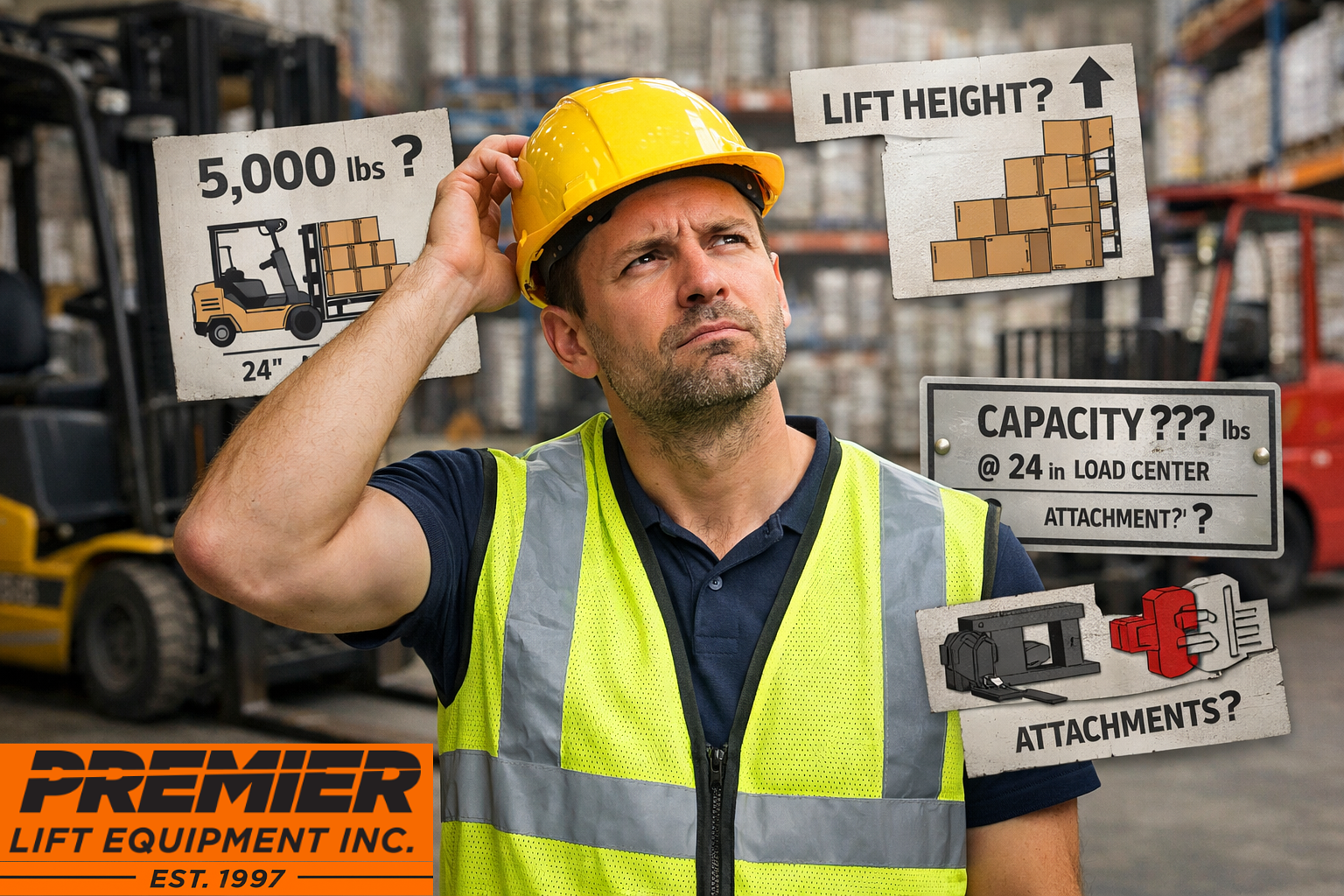
Forklift capacity refers to the maximum weight a forklift can safely lift at a specified load center and lift height. This rating is determined by the manufacturer and is clearly listed on the forklift’s data plate.
For example:
- A forklift rated at 5,000 lbs @ 24 inches means it can safely lift 5,000 pounds when the load’s center of gravity is 24 inches from the forks.
Once you change any of those variables—weight distribution, lift height, or attachments—the effective capacity changes.
Why Forklift Capacity Matters
Operating a forklift beyond its rated capacity can lead to:
- Tip-overs and instability
- Dropped loads
- Accelerated wear on mast, hydraulics, and tires
- Violations during safety inspections
- Serious operator injury or damage to facility infrastructure
Capacity isn’t just a number—it’s a safety limit.
Key Factors That Affect Forklift Capacity
1. Load Weight
This one seems obvious, but it’s often underestimated. Always account for:
- The heaviest pallet you handle
- Seasonal or peak-volume loads
- Variations in pallet weight
If your loads range from 3,000–4,500 lbs, a 5,000-lb truck may technically work—but it leaves little margin for safety or future growth.
2. Load Center
The load center is the distance from the face of the forks to the load’s center of gravity.
- Standard pallets = 24" load center
- Oversized or long loads = 36", 48", or more
As the load center increases, usable lifting capacity drops significantly.
Why Load Center Is the #1 Thing Most People Get Wrong
In the field, the biggest mistake I see is customers assuming weight is the only thing that matters. It isn’t.
The load center — especially on long or awkward loads — changes everything.
A 5,000 lb forklift might lift 5,000 lb at a 24" load center, but stretch that load out to 36" or 48" and the real capacity drops fast.
Most people don’t realize how quickly a load becomes “too long” for the truck they’re using.
3. Lift Height
Forklift capacity is rated at a specific lift height. As you lift higher:
- Stability decreases
- Capacity is reduced
If you’re stacking at 15–20 feet or higher, you may need a higher-capacity forklift than you would for ground-level work—even if the load weight is the same.
4. Attachments
Attachments such as:
- Side shifters
- Fork positioners
- Clamps
- Carpet poles
…all add weight and move the load farther forward. This reduces the forklift’s effective capacity, sometimes by hundreds or even thousands of pounds.
Any attachment requires an updated data plate reflecting the new capacity.
5. Indoor vs. Outdoor Use
Outdoor applications introduce additional variables:
- Uneven surfaces
- Ramps and grades
- Wind exposure with elevated loads
These conditions often justify choosing a forklift with extra capacity headroom.
What I Look for When I Walk Into a Customer’s Warehouse
When I visit a facility, I can usually tell within minutes if the forklift capacity is wrong.
If I walk out back and see oversized loads, I start asking questions about weight, dimensions, and load center.
If I see a mix of odd‑size or inconsistent loads, that’s a red flag — it usually means the fleet wasn’t sized for the worst‑case scenario.
I also look at the forklifts they’re using and check for anomalies — trucks that clearly don’t match the loads they’re lifting.
This is where most capacity problems start.
Common Capacity Ranges (Quick Guide)
- 3,000–4,000 lbs – Light warehouse, dock work
- 5,000–6,000 lbs – Most general warehouse and manufacturing use
- 8,000–10,000 lbs – Lumber, steel, machinery
- 12,000 lbs+ – Heavy industrial and outdoor applications
This is a starting point—not a final answer.
Don’t Size for Today Only
One of the biggest mistakes businesses make is choosing a forklift that only meets current needs. Consider:
- Future product changes
- New racking systems
- Increased throughput
- Additional attachments
Buying slightly more capacity upfront often costs far less than replacing an undersized truck later.
The One Thing I Wish Every Customer Understood
If there’s one thing I wish every customer knew before calling me, it’s this:
Load center matters just as much as weight — and different load centers require different equipment.
A forklift that “should” lift the load on paper can become unsafe the moment the load gets longer, wider, or sits farther out on the forks.
Capacity isn’t just a number — it’s a geometry problem.
CSA & MLITSD Compliance: Why Capacity Isn’t Optional
Under CSA B335‑25 and MLITSD 2026 guidelines, capacity must match the actual load, not the assumed load.
Incorrect capacity affects:
- Stability at height
- Legal operating limits
- Data plate accuracy
- Insurance compliance
- Operator safety
- If attachments or long loads change the load center, the forklift’s capacity must be recalculated and updated on the data plate.
- This is one of the most overlooked compliance issues in Ontario warehouses.
How to Choose the Right Capacity (Simple Checklist)
Before selecting a forklift, ask:
- What is my heaviest load?
- What is the load size and center?
- How high do I need to lift?
- Will I use attachments now or later?
- Is the forklift used indoors, outdoors, or both?
If you’re unsure on any of these, it’s better to pause and confirm than guess.
Forklift capacity isn’t about buying the biggest truck—it’s about buying the right one. A properly sized forklift improves safety, protects your investment, and keeps your operation running efficiently.
If you’re evaluating forklifts and want help confirming the correct capacity for your application, working with an experienced lift equipment provider can save you time, money, and risk. At Premier Lift Equipment, we help customers evaluate load requirements, lift heights, and attachments to ensure their forklifts are properly sized, compliant, and safe for real-world use. Whether you’re buying, renting, or reconfiguring your fleet, our team is here to guide you through the process.
Explore Equipment Sized for Real‑World Loads
- Electric Counterbalance Forklifts — Sized for warehouse loads with accurate load‑center ratings
- Stand‑Up Counterbalance Units — Ideal for tight spaces and mixed‑size pallets
- High‑Capacity Outdoor Forklifts — Built for long, heavy, or uneven loads
- CSA‑Certified Inventory — Fully inspected with updated data plates
Choosing the right capacity protects your operators, your product, and your bottom line.
👉 Schedule a service or fleet assessment