
As warehouse space becomes more expensive and throughput expectations increase, businesses are forced to store more in less space. The solution? Narrow aisle equipment.
But “narrow aisle forklift” isn’t one machine — it’s a category. And choosing the wrong type can limit productivity, increase damage, or create costly workflow bottlenecks.
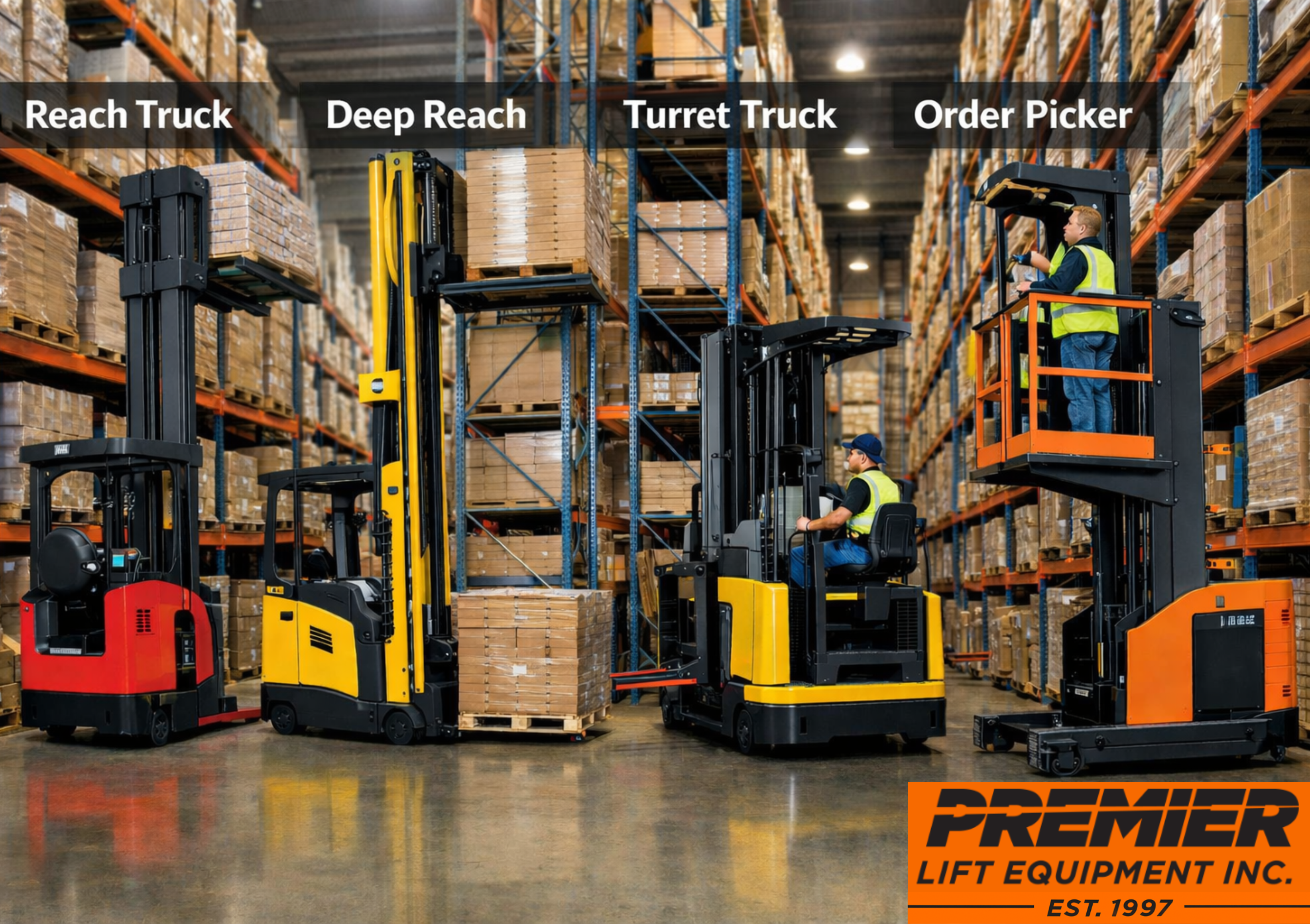
Let’s break down the four most common narrow aisle lift trucks:
- Reach Trucks
- Deep Reach (Double Reach) Trucks
- Turret Trucks (VNA)
- Order Pickers
And more importantly — when each one actually makes sense.
Reach Trucks
A classic narrow aisle solution.
A reach truck is designed for racking applications where the load must extend (reach) forward into the rack. The forks extend past the stabilizing legs, allowing tighter aisle widths than a traditional sit-down forklift.
Key Characteristics:
- Typically operate in 9-10 ft aisles
- Lift heights often 20-30+ feet
- Best for single-deep racking
- Electric-powered
Best For:
- Standard warehouse pallet storage
- High stacking in moderate-density layouts
- Operations prioritizing flexibility
Critical Limitation:
They’re not ideal for outdoor use and don’t perform well on uneven surfaces.
Examples include models from Hyster, Crown Equipment Corporation, and Toyota Material Handling.
Deep Reach (Double Reach) Trucks
Think of this as a reach truck with extended capability.
A deep reach truck can access two pallets deep in racking. Instead of just reaching into the first pallet position, it telescopes further to retrieve the second.
Key Characteristics:
- Works with double-deep racking systems
- Improves storage density
- Similar aisle width to standard reach trucks
Best For:
- Warehouses needing higher pallet density
- Cold storage environments
- High-SKU facilities with selective but dense storage
Trade-Off:
You gain density but sacrifice immediate access to every pallet. The rear pallet must be accessed first.
Turret Trucks (VNA – Very Narrow Aisle)
Now we’re in high-density territory.
Turret trucks operate in very narrow aisles (as tight as 5–6 feet) and feature a rotating turret head that turns the forks left or right without turning the truck.
Some systems are wire-guided or rail-guided for precision.
Key Characteristics:
- Extremely high lift heights (30-40+ feet)
- Operate in fixed aisles
- Maximum vertical cube utilization
Best For:
- Distribution centers
- High-volume storage facilities
- Operations where floor space is at a premium
Important Consideration:
Turret trucks are less flexible. They’re designed to live in those aisles — not travel freely across mixed environments.
Common VNA equipment manufacturers include Jungheinrich and Linde Material Handling.
Order Pickers
Unlike the previous trucks, order pickers are built for piece picking, not just full pallet movement.
The operator platform rises with the forks, allowing workers to manually pick cases or individual items at height.
Key Characteristics:
- Operator elevates with the load
- Designed for case picking and e-commerce
- Various lift heights (low-level to high-level)
Best For:
- E-commerce fulfillment
- Retail distribution
- Operations with high SKU counts
Strategic Advantage:
Order pickers improve picking efficiency but are not intended for heavy pallet movement like reach or turret trucks.
Reach Truck vs Order Picker vs Turret Truck: What Most Buyers Get Wrong
One of the most common mistakes is comparing a reach truck, order picker, and turret truck as though they perform the same job.
They don't.
While all three operate in narrow aisle environments, they solve completely different warehouse problems.
Choose a Reach Truck When:
- Most movement is pallet-in / pallet-out storage
- Operators remain on the ground
- You need flexibility across multiple rack layouts
- You want a balance between storage density and throughput
A reach truck is usually the best choice when the primary goal is storing and retrieving full pallets efficiently. For many warehouses, it delivers the best balance of density, productivity, and operational flexibility.
Choose an Order Picker When:
- Workers pick individual cases or cartons
- Orders contain a large number of SKUs
- Labor efficiency matters more than pallet density
- E-commerce or retail fulfillment drives the operation
Order pickers are designed around people moving to the inventory. If operators spend their day picking products from multiple rack levels, an order picker is often the most productive solution.
Choose a Turret Truck When:
- Floor space is the primary constraint
- Maximum storage density is required
- Aisles can be permanently dedicated to VNA operation
- The facility is designed around high-bay storage
Turret trucks make sense when every pallet position matters and the cost of warehouse space justifies specialized equipment and infrastructure.
The Simple Rule
- If your goal is moving pallets efficiently → Reach Truck
- If your goal is picking products efficiently → Order Picker
- If your goal is storing more inventory in less space → Turret Truck
Many operations purchase the wrong machine because they focus on aisle width instead of workflow. The real question is not how narrow the aisle is. The real question is whether your operation is primarily storing pallets, picking products, or maximizing storage density.
Need Help Balancing Narrow-Aisle Specs vs. Budget? Understanding which narrow-aisle vehicle fits your rack configuration is crucial, but keeping capital costs under control dictates your project's ROI. Explore our tiered inventory starting with our Budget Forklifts & Chassis-Only Hub.
So Which One Should You Choose?
Here’s the reality:
Most operations don’t fail because they bought the wrong forklift.
They fail because they didn’t align the forklift with the racking system, SKU profile, and throughput demands.
Ask yourself:
- Are you pallet in / pallet out — or piece picking?
- Is your bottleneck storage density or labor efficiency?
- Do you need flexibility or maximum cube utilization?
- Are your aisles fixed or subject to layout changes?
If you’re running standard selective racking and want flexibility → Reach Truck
If you need higher pallet density without going full VNA → Deep Reach
If you want maximum vertical cube usage → Turret Truck
If you’re picking individual SKUs → Order Picker
Common Signs You've Outgrown a Standard Forklift
Many operations begin with a counterbalance forklift because it offers flexibility across a variety of warehouse environments. However, as storage density increases, facilities often reach a point where traditional forklift layouts become the limiting factor rather than available square footage.
Common indicators that a warehouse may benefit from a reach truck, deep-reach truck, or other narrow-aisle equipment include:
Aisles consuming valuable storage space
Rack heights increasing beyond traditional warehouse layouts
Pressure to increase pallet positions without relocating
Double-deep storage requirements
Growing order volumes that demand faster picking efficiency
In these situations, warehouse operators frequently compare reach truck designs, storage-density strategies, aisle requirements, and available equipment configurations—such as the trends covered in our analysis of why reach truck designs are expanding across GTA warehouses—before selecting a long-term solution.
Narrow aisle equipment isn’t just about tighter aisles. It’s about engineering your warehouse around flow, density, and long-term scalability.
The wrong choice locks you into inefficiency for years.
The right choice compounds productivity.
If you’re considering upgrading your narrow aisle equipment or redesigning your layout, now is the time to evaluate it strategically — not reactively.
Explore Narrow-Aisle & Specialized Equipment Categories
If you are optimizing vertical rack height or upgrading your narrow-aisle fleet, Premier Lift can help you determine the correct equipment configuration and supply machinery matching your facility requirements:
- Refurbished Reach Trucks & Deep-Reach Units: For high-density racking and tight turnaround aisles.
- Turret Trucks & Order Pickers: Specialized VNA equipment built for high-lift environments.
The Premier Strategy™ Framework Operating in the GTA means navigating strict CSA and Ministry of Labour audit requirements. Depending on your facility’s capital and compliance timeline, Premier Lift Equipment offers two tailored procurement paths:
- Explore Premier Certified™ Units: Fully reconditioned, CSA-aligned, and audit-ready equipment designed to eliminate compliance gaps and beat OEM wait times.
- Explore Premier Budget™ Options: Fully CSA-approved, reconditioned, safety-certified economy units and unbundled chassis solutions tailored for operations looking for reliable mechanical performance without paying for redundant overhead. Need help selecting the right tier for your floor? Call our Brampton yard directly at 99 West Drive.
Need Help Selecting the Right Forklift?
Our material handling specialists can help identify the correct equipment and narrow-aisle solution for your facility.
✅ Call Our Brampton Team Directly