
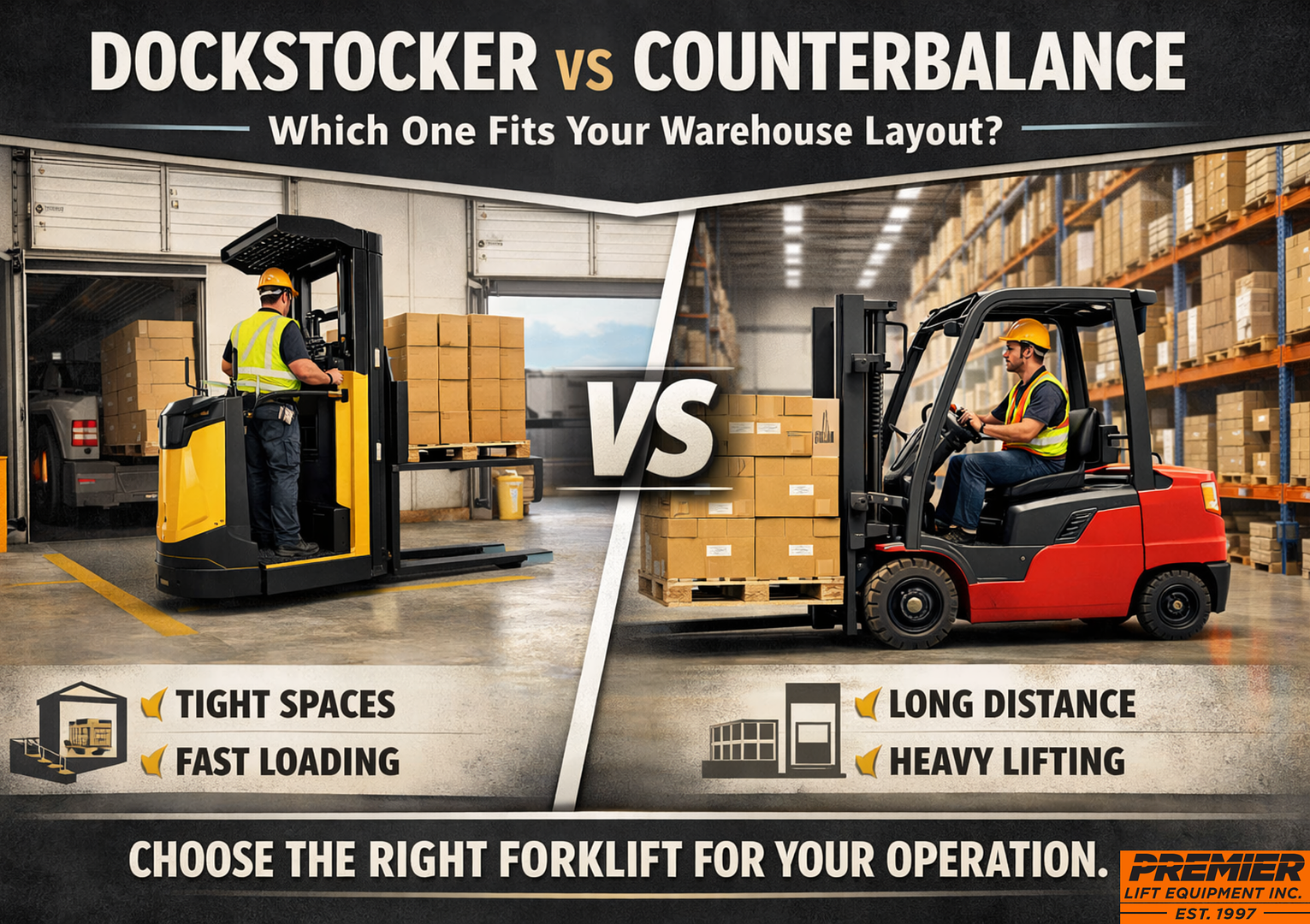
Choosing the wrong forklift for your layout doesn’t just slow you down—it creates bottlenecks, increases damage risk, and quietly drives up your operating costs.
Two of the most commonly compared options are dockstockers and counterbalance forklifts. On paper, they may seem interchangeable. In reality, they are built for completely different environments.
If you’re deciding between the two, this guide will help you understand which one actually fits your operation—and why the wrong choice costs more than you think.
What Is a Dockstocker?
A dockstocker (also called a stand-up rider or dock truck) is designed specifically for high-frequency loading and unloading at dock doors.
Best Use Cases:
- Trailer loading and unloading
- Short travel distances
- Tight dock areas
- High cycle, repetitive work
What I Look for the Moment I Walk Into a Warehouse
When I walk into a warehouse, I’m not looking at the forklifts first — I’m watching the operators. How often are they getting on and off the truck? How much space do they have to maneuver? How confident are they with stand‑up controls? A stand‑up is a different animal to learn, and operator competency matters. I also look at travel distance, dock congestion, and whether the workflow is dock‑heavy or spread across the building. The operator’s job tasks tell me exactly which truck they actually need.
Most People Choose Wrong Because They Think Sit‑Down = More Stable
One of the biggest misconceptions I see is people assuming a sit‑down counterbalance is “more stable” or “safer” just because it has a seatbelt. They don’t realize a stand‑up dockstocker is ergonomically designed for operators who need to get on and off the truck constantly while multitasking. The real question isn’t stability — it’s workflow. If your operators are climbing in and out all day, a stand‑up is the safer, faster, more efficient choice.
Key Advantages:
- Compact footprint for tight spaces
- Fast on/off operation for operators
- Excellent visibility in dock environments
- Quick direction changes for high productivity
Limitations:
- Not ideal for long travel distances
- Limited comfort for extended shifts
- Less suited for outdoor or rough surfaces
Bottom line: Dockstockers thrive in fast-paced dock environments where speed and maneuverability matter most.
What Is a Counterbalance Forklift?
A counterbalance forklift is the most common forklift type, designed for general-purpose material handling across a wide range of environments.
Best Use Cases:
- Indoor and outdoor applications
- Moving loads across longer distances
- Yard work and uneven surfaces
- Racking and general warehouse use
Key Advantages:
- Versatility across multiple applications
- Higher travel efficiency over distance
- Available in electric, propane, and diesel
- Better suited for heavier loads and varied tasks
Limitations:
- Requires more aisle space
- Slower in tight dock environments
- Less efficient for constant on/off cycles
Bottom line: Counterbalance forklifts are built for flexibility—but not always for speed in tight dock conditions.
The Real Difference: Layout, Not Preference
Most buyers make the mistake of choosing based on price or familiarity. The right decision comes down to how your warehouse actually operates.
Ask Yourself:
- Are your operators constantly getting on and off the truck? → Dockstocker
- Are they traveling long distances across the facility? → Counterbalance
- Is your operation centered around dock doors? → Dockstocker
- Do you need one unit to handle multiple job types? → Counterbalance
If your workflow is dock-heavy and repetitive, a dockstocker will outperform a counterbalance every time.
If your operation is varied and spread out, a counterbalance is the better fit.
Your Workflow Chooses the Forklift — Not Your Preference
If there’s one thing I wish every warehouse manager understood, it’s this:
A counterbalance at the dock is a silent productivity killer, and a dockstocker across the warehouse is a fatigue machine.
These trucks are built for completely different jobs. When you match the forklift to the operator’s actual workflow, everything gets faster, safer, and cheaper. When you don’t, you pay for it every single shift.
The Hidden Cost of Choosing Wrong
This is where most operations underestimate the impact.
Using a Counterbalance at the Dock:
- Slower cycle times
- Increased operator fatigue
- More congestion at dock doors
Using a Dockstocker Across the Warehouse:
- Inefficient long-distance travel
- Reduced productivity outside dock areas
- Operator discomfort over longer shifts
The result? Lost time, higher labour costs, and unnecessary wear on equipment.
Can You Use Both?
In many operations, the best answer isn’t one or the other—it’s both.
High-efficiency warehouses often use:
- Dockstockers at the doors for loading/unloading
- Counterbalance forklifts for transport, staging, and yard work
This combination allows each machine to do what it was designed for, maximizing productivity across the entire facility.
Where Each Truck Truly Excels (Based on Real‑World Data)
- Dockstockers (Raymond, Crown, Toyota)
- Built for high‑cycle dock work, tight maneuvering, and rapid on/off tasks.
- Counterbalance Forklifts (Toyota, Hyster‑Yale, Clark)
- Designed for longer travel, mixed environments, and heavier, varied loads.
- Stand‑Up vs Sit‑Down
- Stand‑up = speed, ergonomics, and dock efficiency.
- Sit‑down = distance, comfort, and stability over longer runs.
Choosing based on brand or habit is how operations get bottlenecked. Choosing based on workflow is how operations scale.
How to Choose the Right Fit
Before making a decision, evaluate:
1. Your Layout
- Aisle width
- Dock configuration
- Travel distances
2. Your Workflow
- Frequency of loading/unloading
- Distance per load cycle
- Number of operators
3. Your Growth Plans
- Will volume increase?
- Will your layout change?
- Are you scaling dock operations?
The right equipment should not just fit your current operation—it should support where you’re going next.
The Bottom Line
There’s no “better” forklift—only the one that fits your operation.
- Dockstocker = Speed + Efficiency at the Dock
- Counterbalance = Versatility + Range Across the Warehouse
Choosing correctly means:
- Faster throughput
- Lower labour costs
- Less equipment strain
- Safer operations
Choosing wrong means paying for it every single day.
Not Sure Which One Fits Your Operation?
Most warehouses don’t need more equipment—they need the right equipment in the right place.
If you’re unsure whether a dockstocker, counterbalance, or combination makes the most sense, we can help you evaluate your layout and recommend the most efficient setup for your operation.
Explore the Right Equipment for Your Workflow
- Dockstockers / Stand‑Up Riders — Built for speed at the dock
- Electric Counterbalance Forklifts — Ideal for mixed warehouse travel
- Reach Trucks — For high‑lift racking environments
- VNA / Turret Trucks — For ultra‑narrow aisle optimization
The right forklift isn’t the one you prefer — it’s the one that fits your operation.
👉 Browse our dockstocker inventory here!