
Electric forklifts are becoming more popular every year, especially for buyers looking at older budget units. But there’s one part of electric forklift ownership that almost every buyer misunderstands — and it’s the part that determines performance, cost, and long‑term ROI more than anything else:
The battery and charger.
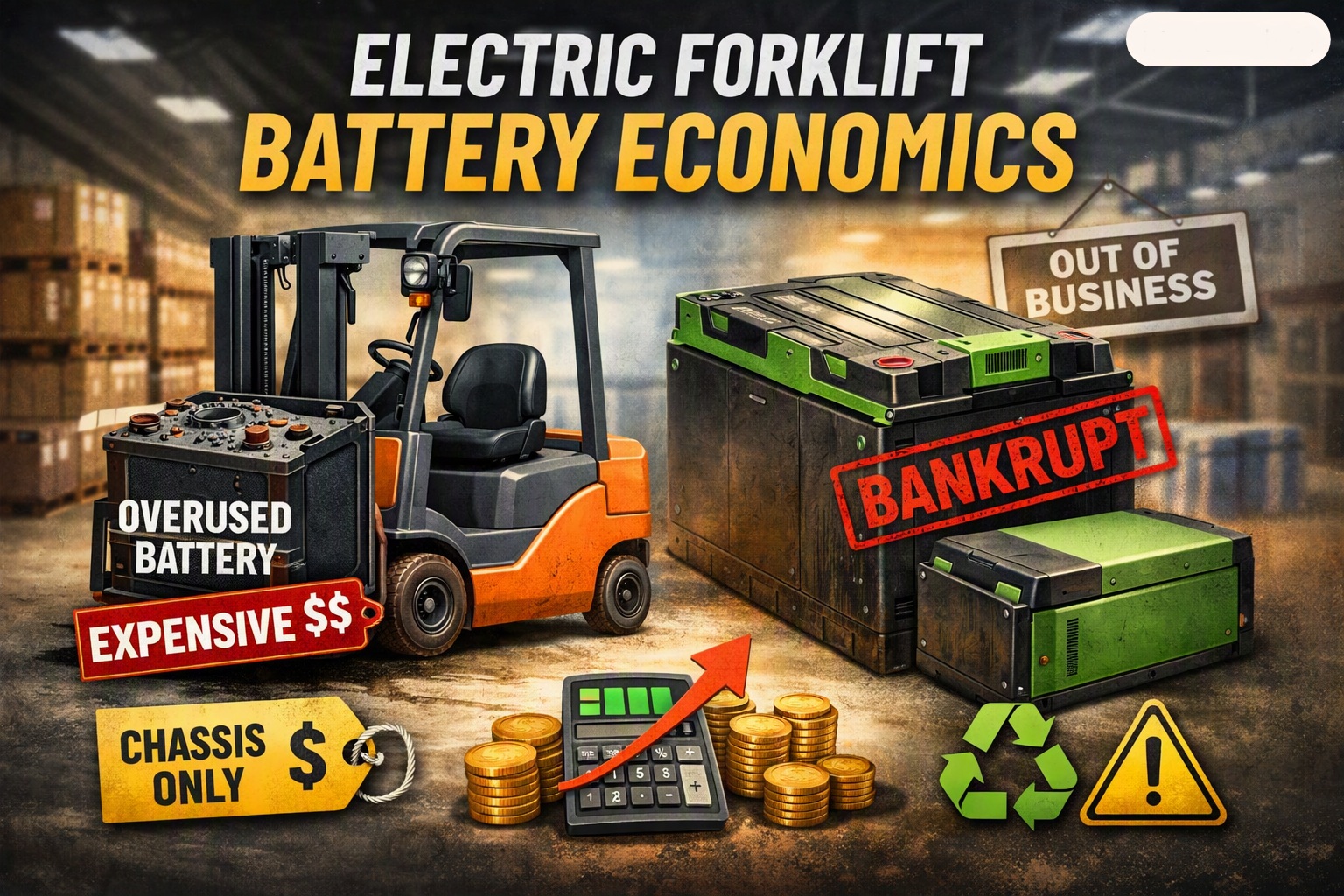
In many cases, especially with older electric forklifts, the battery and charger are worth more than the forklift chassis itself. This is the single biggest reason buyers hesitate when they see chassis‑only pricing. And it’s also the biggest opportunity to build trust, educate customers, and help them make confident decisions.
This blog explains Battery Economics in real‑world terms — not manufacturer marketing — so buyers understand what they’re actually paying for, why battery pricing matters, and why budget electric forklifts still make sense when the costs are explained properly.
Read the full Battery Economics Standard here:
Battery Economics Landing Page
Runtime: Why It’s Never a Fixed Number
Manufacturers love to advertise “8‑hour runtime,” but real warehouses don’t operate in perfect conditions. Runtime depends on:
- travel distance
- lift frequency
- load weight
- warehouse temperature
- battery age
- charger type
- operator behavior
Light duty may get 6–8 hours.
Heavy duty may get 3–5 hours.
Cold storage can cut runtime dramatically.
Your workflow determines your runtime — not the brochure.
Charger Matching: The Most Overlooked Factor in Battery Lifespan
A battery is only as good as the charger it’s paired with.
Chargers must match voltage, amp‑hour rating, battery chemistry, and charging curve. Using the wrong charger can shorten battery lifespan, reduce runtime, cause sulfation, and even void manufacturer warranties.
Opportunity charging is convenient, but it stresses lead‑acid batteries and can void warranties if used improperly.
Learn more about our Equipment Compliance & Quality process:
Equipment Compliance & Quality Page
Lead‑Acid Batteries: Proven, Reliable, But Maintenance‑Dependent
Lead‑acid batteries are predictable, cost‑effective, and supported by mature recycling infrastructure. But their lifespan depends entirely on:
- watering discipline
- cleanliness
- sulfation control
- full‑cycle charging
- operator habits
A well‑maintained lead‑acid battery can last years.
A neglected one can fail in months.
Lithium Batteries: High Performance, Low Maintenance, Higher Risk
Lithium batteries are the future — but buyers need to understand the real‑world risks.
Lithium advantages:
- excellent runtime
- fast opportunity charging
- minimal daily maintenance
- consistent performance
Lithium risks:
- higher upfront cost
- inconsistent real‑world lifespan
- limited disposal infrastructure
- expensive replacement packs
- manufacturer bankruptcy risk
A real example from our field experience
Premier Lift Equipment had a case where a customer purchased a forklift with a lithium battery. The battery failed while still within its expected lifespan. When we contacted the manufacturer, we discovered:
- the company had gone out of business
- no warranty support
- no replacement packs
- no disposal pathway
- no technical documentation
The customer was left stranded with a battery they couldn’t repair, replace, or recycle.
See our Electric Forklift inventory:
Battery Cost vs Chassis Cost: The Truth Buyers Need to Hear
Here’s the part most buyers don’t know:
On older electric forklifts, the battery and charger often cost more than the forklift chassis.
Lead‑acid examples:
- A healthy industrial battery can exceed the value of an older forklift
- Replacement batteries often cost more than the truck in Budget or older CSA categories
- Chargers add additional cost, especially if a matched unit is required
Lithium examples:
- Lithium packs are almost always more expensive than the forklift chassis
- Replacement lithium packs can exceed the total value of the forklift
- Disposal infrastructure is inconsistent
- Manufacturer support is not guaranteed
This is especially true for sit‑downs, reach trucks, and walkies.
View our Walkie inventory:
Total Cost of Ownership: What Buyers Should Consider
Your long‑term cost depends on:
- battery purchase cost
- charger compatibility
- maintenance requirements
- expected lifespan
- replacement cycles
- disposal or recycling costs
- downtime exposure
- warranty coverage
Lead‑acid offers predictable maintenance and lower upfront cost.
Lithium offers convenience but carries higher replacement and disposal risk.
Updated GTA pricing will be added once confirmed by our team.
Environmental & Disposal Considerations
Lead‑acid batteries:
- fully recyclable
- predictable end‑of‑life process
- mature infrastructure
Lithium batteries:
- inconsistent disposal pathways
- limited recycling options
- environmental impact varies
- manufacturer support is critical
Why This Matters for Budget Electric Forklifts
This blog — and the Battery Economics Standard — directly supports our sales team, especially Dwight, when selling older budget electric forklifts.
Buyers often ask:
- “Why is the battery so expensive?”
- “Why is the charger extra?”
- “Why is the chassis‑only price so low?”
- “Why does the battery cost more than the forklift?”
This blog gives them the answers before they ask — building trust, reducing objections, and helping close more deals.
Browse our Budget Forklifts here:
Read Next
- Understanding Chassis‑Only Pricing
- Electric Forklift Buyer FAQ
- Lead‑Acid vs Lithium: Which Battery Fits Your Workflow?
Visit our Standards, Transparency & Buyer Knowledge Hub: