
Why Older Forklifts Still Make Sense in 2026
Published:
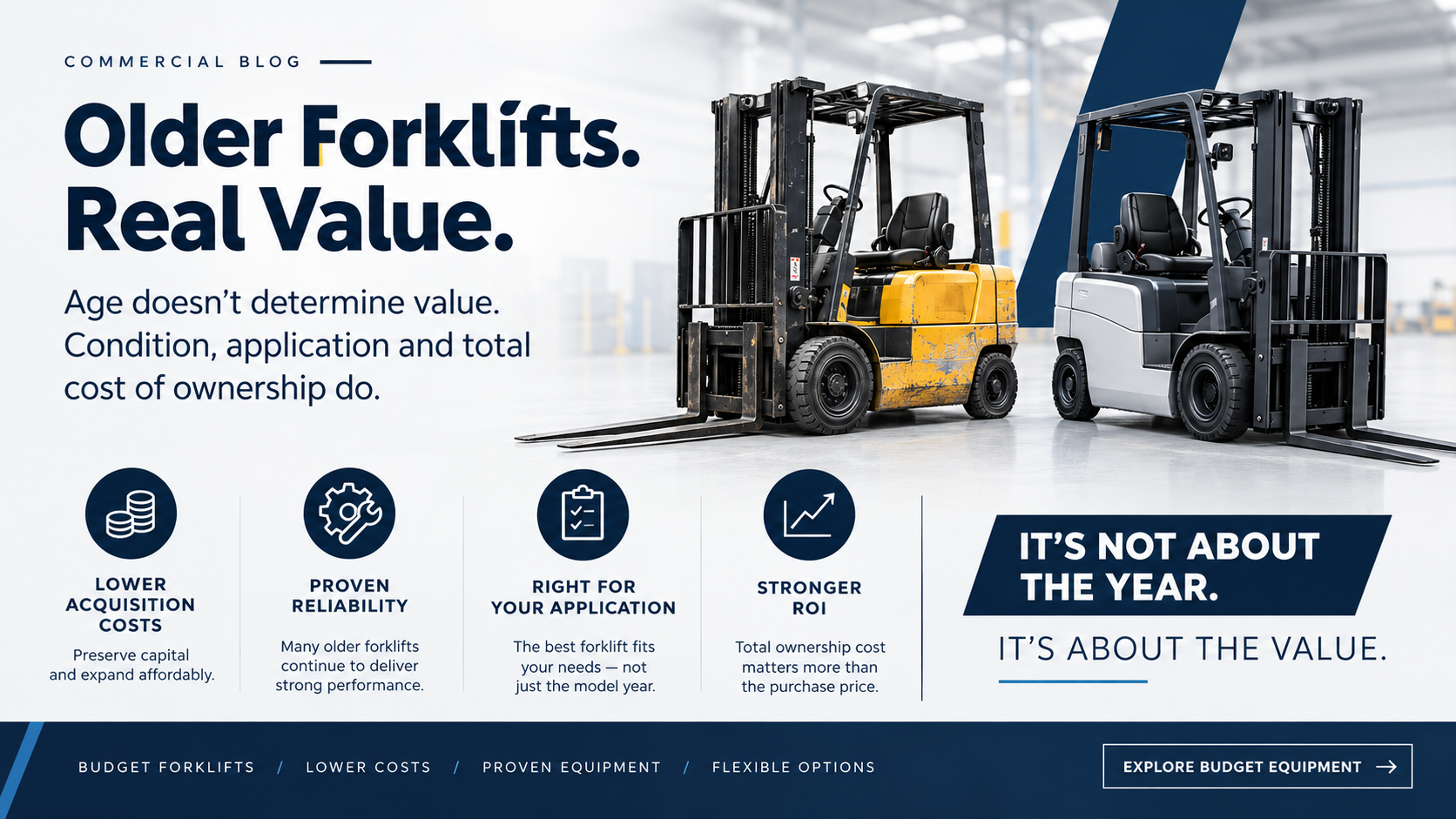
Every used forklift buyer eventually asks the same question:
"Why would I buy an older forklift when newer equipment is available?"
It's a fair question. But in today's market, age alone tells very little about whether a forklift is a good investment.
Many buyers automatically eliminate equipment based on model year or hours before evaluating the factors that actually determine value. In reality, some older forklifts continue delivering reliable service for years while some newer units struggle with maintenance issues, battery costs, parts availability, or ownership expenses.
The best forklift is not always the newest forklift.
The best forklift is the one that meets the application's requirements while delivering the strongest return on investment.
Age Is Not the Same as Condition
One of the biggest misconceptions in the material handling industry is that equipment value is determined primarily by age.
Industrial forklifts should be evaluated based on:
- maintenance history
- operating environment
- component condition
- battery condition
- charger compatibility
- refurbishment quality
- intended application
A properly maintained forklift with higher hours can often deliver better long-term value than a newer machine that has been neglected or improperly maintained.
Condition determines value.
Age simply provides context.
Why Many Operations Deliberately Purchase Older Equipment
Not every facility requires the newest equipment available.
Many buyers are focused on:
- preserving capital
- expanding fleets affordably
- adding backup equipment
- supporting seasonal demand
- replacing occasional-use units
- reducing acquisition costs
In these situations, purchasing older equipment can be a practical business decision rather than a compromise.
The objective is not always to purchase the newest forklift.
The objective is to purchase the forklift that delivers the best financial outcome for the intended application.
The Current Market Has Changed Buyer Priorities
Many organizations are operating under tighter capital budgets and increased pressure to manage operating costs.
As equipment prices continue to rise, buyers are increasingly evaluating alternatives that allow them to:
- preserve cash flow
- delay large capital expenditures
- expand capacity without significantly increasing debt exposure
- maintain operational flexibility
For many operations, older equipment provides an opportunity to continue serving customers while reducing acquisition costs.
Understanding the Real Cost of Ownership
Purchase price is only one part of the equation.
Long-term ownership costs may include:
- battery replacement
- charger upgrades
- maintenance
- repairs
- operator training
- downtime exposure
- replacement planning
The lowest purchase price does not always create the lowest operating cost.
However, in the right application, older equipment can provide exceptional value when ownership costs are properly understood before purchase.
Buyers evaluating older electric equipment should also understand how battery age, charger compatibility, runtime expectations, and replacement planning affect long-term ownership costs. Our Battery Economics Standard explores these factors in greater detail.
Older Equipment Still Has a Place
Industrial equipment is designed to work.
Many forklifts remain productive long after buyers assume their useful life has passed.
The key is identifying equipment that matches the application, workload, budget, and operational requirements of the business.
For some operations, investing in newer equipment is the right decision.
For others, proven older equipment may provide the strongest return on investment available.
The answer depends on the application, not the model year.
A Different Ownership Strategy
At Premier Lift Equipment, we recognize that different operations have different ownership priorities. Some buyers prioritize lower acquisition costs, capital preservation, and operational flexibility, while others prioritize compliance readiness, uptime, and reduced operational uncertainty.
This is the foundation of our Premier Budget™ and Premier Certified™ equipment strategies.
Premier Budget™ equipment supports buyers focused on value and lower acquisition costs, while Premier Certified™ equipment is designed for operations seeking greater operational confidence, documentation, and compliance-focused preparation.
Neither approach is inherently better. The right choice depends on operational requirements, utilization levels, risk tolerance, and ownership objectives.
Pricing Transparency Matters
One reason buyers often struggle when comparing older equipment is that not all forklifts are configured the same way.
Battery packages, chargers, attachments, compliance requirements, and refurbishment scope can dramatically influence the final cost of ownership.
For buyers seeking additional pricing transparency, our Chassis-Only Pricing Framework explains how separating equipment, batteries, and chargers can provide a clearer understanding of total ownership cost and future replacement planning.
Explore Budget Equipment Opportunities
Many older forklifts continue providing reliable service in warehouses, manufacturing facilities, transportation operations, and distribution environments.
For buyers seeking lower acquisition costs and greater flexibility, budget equipment remains an important part of the material handling market.
Browse our available Budget Forklift inventory to explore equipment that may fit your operational requirements, ownership strategy, and capital budget.