
How Many Pallet Moves Per Day Justify Switching to an Electric Pallet Jack?
Published:
Every warehouse reaches a quiet tipping point where a manual pallet jack stops being an economical choice and starts draining labor capital.
The challenge is that the change happens gradually. Operators become slower as fatigue sets in, product staging takes longer, and management accepts the inefficiency simply because it accumulated over time. For growing warehouses and 3PL distribution hubs, the question is no longer whether electric pallet jacks are better, but at what exact volume does the investment pay for itself?
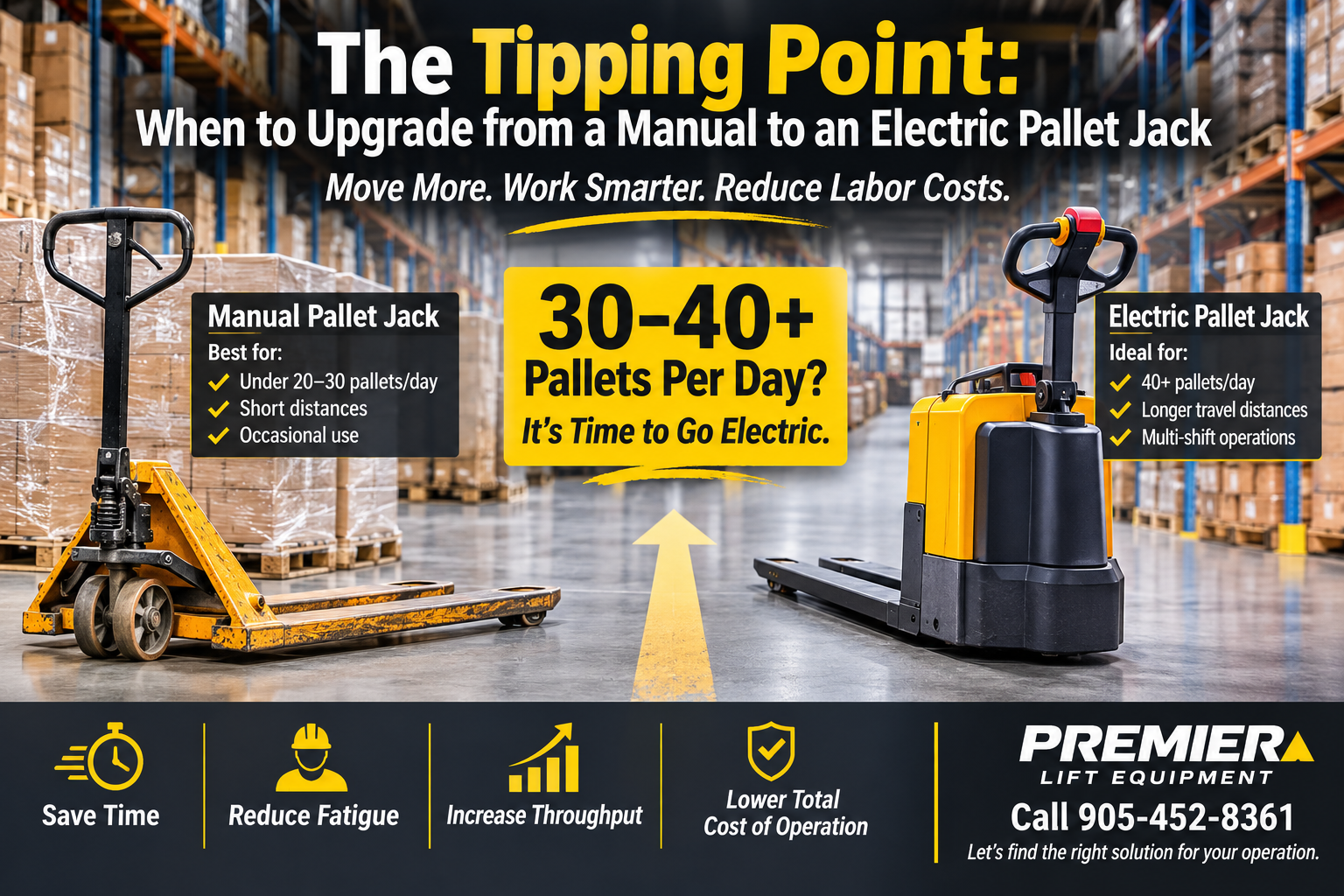
As a general benchmark, operations moving more than 30 to 40 pallets per day across travel distances exceeding 50 feet typically find that manual jacks cost more in lost labor than an electric pallet jack costs to own.
The Biggest Mistake Buyers Make: Purchase Price vs. Total Cost of Operation
Most buyers compare the upfront price of an electric pallet jack directly against a $350 manual pallet jack.
That is the wrong comparison.
The real comparison evaluates total operational drag:
- Labour Hours: How many productive hours are lost pushing dead weight across concrete?
- Operator Fatigue: Is physical exhaustion leading to slower shifts or high staff turnover?
- Travel Distance & Bottlenecks: Are receiving docks and staging lanes backing up during peak hours?
- Forklift Misallocation: Are expensive sit-down or reach trucks being tied up for simple horizontal transport?
A manual pallet jack costs less to acquire, but in a high-volume facility, it becomes the most expensive piece of equipment on your floor.
When Manual Pallet Jacks Still Make Sense
We believe in honest material handling. Manual pallet jacks remain an elite, cost-effective solution for specific environments:
- Light-duty operations moving under 20–30 pallets a day.
- Short travel distances within compact backrooms or small facilities.
- Occasional pallet movement and auxiliary backup equipment.
If your operators only move a limited number of pallets daily across short spans, stick with manual equipment. Not every operation needs power.
The Tipping Point: When Electric Pallet Jacks Start Making Financial Sense
Electric pallet jacks become financially essential when your operation crosses specific operational thresholds:
- High Daily Volume: Consistently moving 40+ pallets daily.
- Extended Travel Spans: Moving goods from receiving docks deep into warehouse racking aisles.
- Multi-Shift Demands: Operations running evening or 24/7 cycles where physical stamina degrades rapidly.
- Bottleneck Elimination: Staging zones requiring fast, motorized turnaround to keep trucks moving.
At this threshold, labor efficiency and throughput outweigh initial equipment cost. The goal is not just moving pallets—it is moving more inventory with less physical strain and zero dock delays.
Walkie vs. Rider Pallet Jack: Which One Do You Actually Need?
Not all electric pallet jacks are built for the same workflow. Selecting the wrong configuration wastes capital:
- Walkie Pallet Jacks (Walk-Behind): Best for moderate travel distances, trailer loading/unloading, general dock work, and tight aisles where operators walk alongside the unit.
- Rider Pallet Jacks (Stand-Up/Platform): Best for long travel distances, high-throughput distribution facilities, large trailer yards, and multi-shift environments where operator speed is paramount.
Battery Runtime & Infrastructure: The Hidden Buying Factor
One of the most overlooked buying decisions is how the power source matches your shift schedule. Runtime is dictated by:
- Duty cycle and continuous transit time.
- Charging opportunities (opportunity charging vs. full shift cycles).
- Temperature (cold storage and freezer environments drain batteries faster).
The cheapest battery package is rarely the most economical. A properly matched battery and charger system prevents mid-shift downtime, premature cell failure, and unexpected replacement costs.
The Premier Strategy: Buy For Workflow, Not Just Specifications
A warehouse moving 50 pallets a day across a compact footprint has radically different needs than a 3PL facility moving 500 pallets across a football-field-sized distribution center.
This is why successful fleet management evaluates real-world workflow first and equipment specifications second:
- What are your actual daily pallet counts?
- What is the average transit distance per pick?
- Are you operating under standard ambient temperatures or cold storage?
Whether you choose a reconditioned unit from our Premier Budget™ lineup for older chassis savings or a fully inspected Premier Certified™ compliance unit, matching the equipment to your actual floor dynamics is what protects your bottom line.
Summary: Is It Time to Upgrade?
Electric pallet jacks are not automatically required for every warehouse. However, once volume, travel distance, and labor demands cross your operational tipping point, motorized equipment transforms productivity.
The most important question is no longer: "Should I buy an electric pallet jack?"
The better question is: "Has my operation reached the point where a manual pallet jack is costing more than it saves?"
Ready to Optimize Your Material Flow?
If you're evaluating whether to upgrade your material handling fleet, our team at Premier Lift Equipment is here to help you analyze your workflow—not just sell you a machine.
- Call Direct: Speak with our Brampton technical center at 905-452-8361
- Explore Inventory: View our fully inspected, certified electric pallet jacks and material handling solutions ready for GTA-wide delivery.