
High Hours vs Poor Condition: What Most Forklift Buyers Get Wrong
Published:
High Hours vs Poor Condition: What Most Forklift Buyers Get Wrong
In many high-throughput facilities, higher hours simply mean a forklift did its job.
A lift truck that accumulated 10,000+ hours in a disciplined, multi-shift distribution center—backed by strict preventive maintenance logs and professional battery care—is often a safer bet than a 2,000-hour warehouse unit that sat neglected, unserviced, and exposed to extreme temperature swings.
High hours don't signal high risk; they signal consistent utility.
Why Buyers Focus on Hours
Hours are easy to understand.
Just as buyers often evaluate a used vehicle by mileage, many forklift buyers use operating hours as a quick way to estimate wear and remaining life.
The problem is that two forklifts with identical hours can have dramatically different conditions depending on:
- maintenance practices
- operating environment
- operator habits
- battery management
- service records
- component replacement history
Hours alone cannot tell the entire story.
What High Hours Can Actually Mean
In many cases, higher hours simply mean a forklift was useful.
It may have spent years operating in a productive warehouse, distribution center, manufacturing facility, or shipping environment while receiving regular maintenance and scheduled repairs.
When equipment is properly maintained, industrial forklifts can accumulate substantial operating hours while continuing to provide reliable performance.
High hours do not automatically indicate high risk.
They often indicate that the equipment was consistently utilized for its intended purpose.
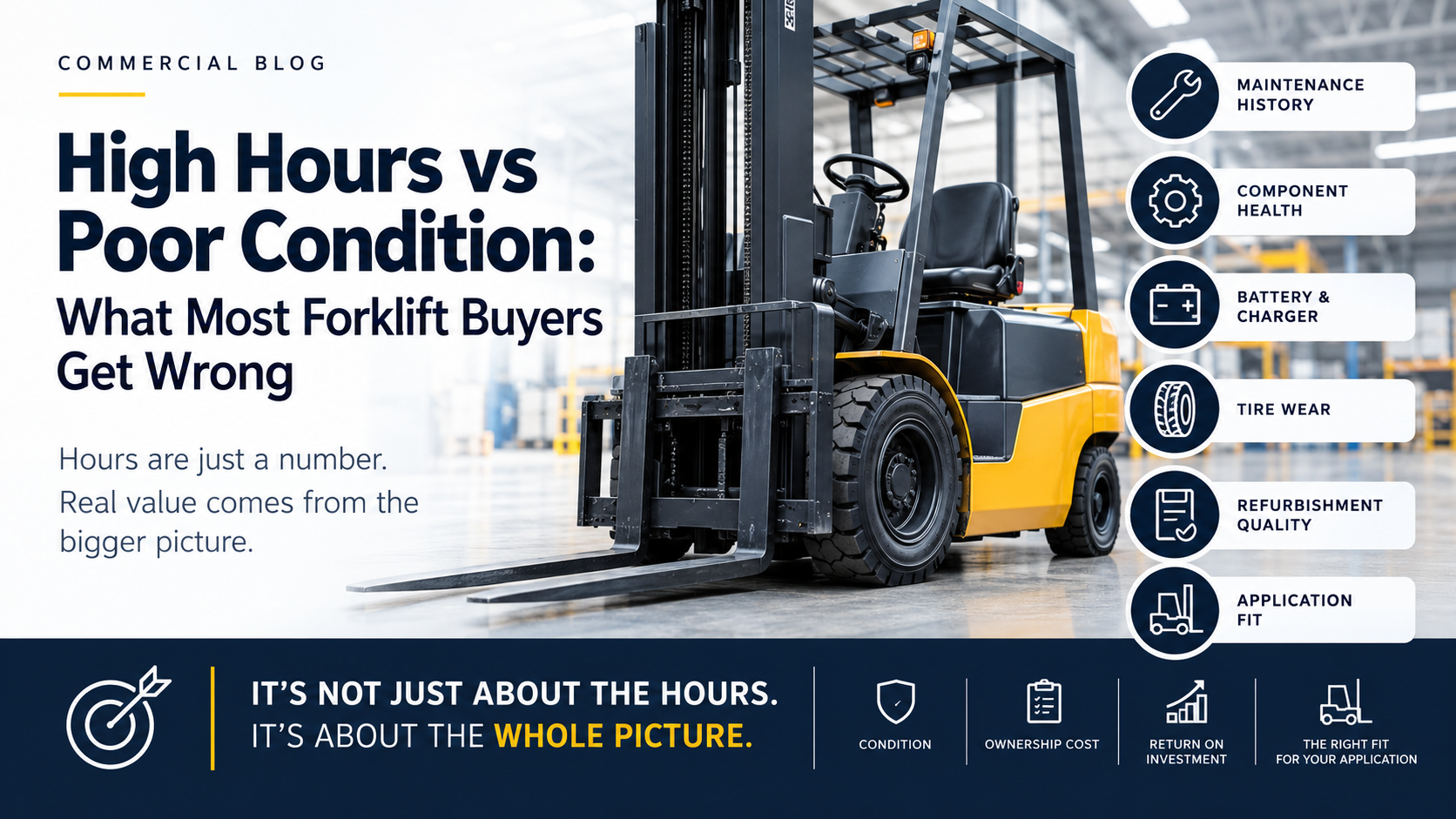
What Buyers Should Evaluate Instead
A forklift should be evaluated as a complete machine rather than a single number.
Some of the most important considerations include:
- overall condition
- maintenance history
- mast condition
- hydraulic system performance
- battery condition
- charger compatibility
- tire wear
- drive motor performance
- refurbishment history
- expected application
These factors usually have a greater impact on ownership experience than the hour meter alone.
A Low-Hour Forklift Is Not Always a Better Forklift
Many buyers assume that lower hours automatically reduce ownership risk.
However, equipment that sits unused for extended periods can create a different set of concerns.
Batteries deteriorate with time.
Hydraulic seals can age.
Maintenance may be deferred.
Service records may become inconsistent.
A lower-hour forklift that has been neglected can ultimately become a more expensive ownership experience than a higher-hour forklift that has been maintained properly.
Condition remains more important than the number displayed on the hour meter.
Understanding the Premier Budget™ Ownership Strategy
This is one reason Premier Lift Equipment focuses on ownership strategy rather than hours alone.
The Premier Budget™ strategy is designed for buyers who prioritize acquisition cost, capital preservation, operational flexibility, and return on investment.
For many applications, a forklift with higher hours but appropriate condition and realistic ownership expectations can provide exceptional value compared to significantly more expensive alternatives.
Buyers exploring our Premier Budget™ inventory quickly discover that value is determined by much more than age or hours. A forklift's condition, application fit, and expected service life are often far more important than the number on the meter.
The goal is not to identify the forklift with the lowest hours.
The goal is to identify the forklift that best aligns with the application's operational requirements and financial objectives.
Age, Hours, and Value Are Not the Same Thing
A forklift's value is determined by the relationship between:
- acquisition cost
- condition
- expected service life
- maintenance requirements
- operational demands
- total cost of ownership
Hours provide useful context, but they should never be the only factor driving a purchase decision.
Many buyers discover that a properly evaluated higher-hour forklift offers a stronger return on investment than newer or lower-hour equipment carrying a significantly higher purchase price.
For operations evaluating older electric equipment, battery condition can also have a major impact on value. In fact, the battery and charger often influence ownership costs more than the forklift chassis itself, which is one reason our Battery Economics framework has become such an important buyer resource.
Pricing Transparency Matters
Another common mistake is comparing forklifts based only on age, hours, or asking price.
A complete ownership evaluation should consider:
- battery condition
- charger compatibility
- refurbishment history
- attachments
- compliance requirements
- future replacement costs
Our Chassis-Only Pricing Framework was created to help buyers understand exactly where their investment is going and eliminate assumptions when comparing equipment options.
Transparent pricing leads to better purchasing decisions.
Making Better Equipment Decisions
The best equipment decisions happen when buyers focus on value, application fit, and ownership cost rather than age or hours alone.
Industrial forklifts are tools designed to generate productivity.
When matched to the right application, properly maintained equipment can continue delivering value long after many buyers assume its useful life has ended.
Before dismissing a forklift because of hours, evaluate the complete ownership picture.
The number on the meter may be far less important than you think.
Frequently Asked Questions
Q: Are high-hour forklifts a bad investment?
A: Not necessarily. High hours do not automatically indicate high risk; they often indicate consistent utility. A forklift with 10,000+ hours backed by strict preventive maintenance and professional care is frequently a safer buy than a neglected, low-hour unit that sat unused.
Q: What matters more when buying a used forklift: hours or condition?
A: Condition, maintenance history, component health, and application fit are far more important than the number on the hour meter. A forklift should always be evaluated as a complete machine rather than relying on a single mileage metric.
Q: Why might a low-hour used forklift be risky?
A: Equipment that sits unused for extended periods can suffer from degraded batteries, aged hydraulic seals, and deferred maintenance. Neglected low-hour machines can often result in higher ownership and repair costs than properly maintained higher-hour units.
Q: What is the Premier Budget™ ownership strategy?
A: The Premier Budget™ strategy helps buyers focus on total acquisition cost, capital preservation, and return on investment by matching older or higher-hour equipment to the right operational requirements through transparent pricing and condition grading.
Explore Related Buyer Resources
To learn more about value-focused equipment purchasing and ownership strategies, explore:
✅ Why Older Forklifts Still Make Sense in 2026
✅ Premier Budget™ Forklifts | Older & Chassis-Only Units
✅ Battery Economics: The Hidden Costs Behind Electric Forklifts
✅ Chassis-Only Pricing: Full Transparency
Whether you're focused on capital preservation, fleet expansion, or identifying the best return on investment, understanding the relationship between condition, ownership costs, and operational requirements will help you make better equipment decisions.
Need Help Selecting the Right Forklift?
Our material handling specialists can help identify the correct equipment and compliance tier for your facility.
✅ Call Our Brampton Team Directly