
Freezer-Rated Forklifts: What Most Cold Storage Operations Get Wrong at -20°C to -30°C
Published:
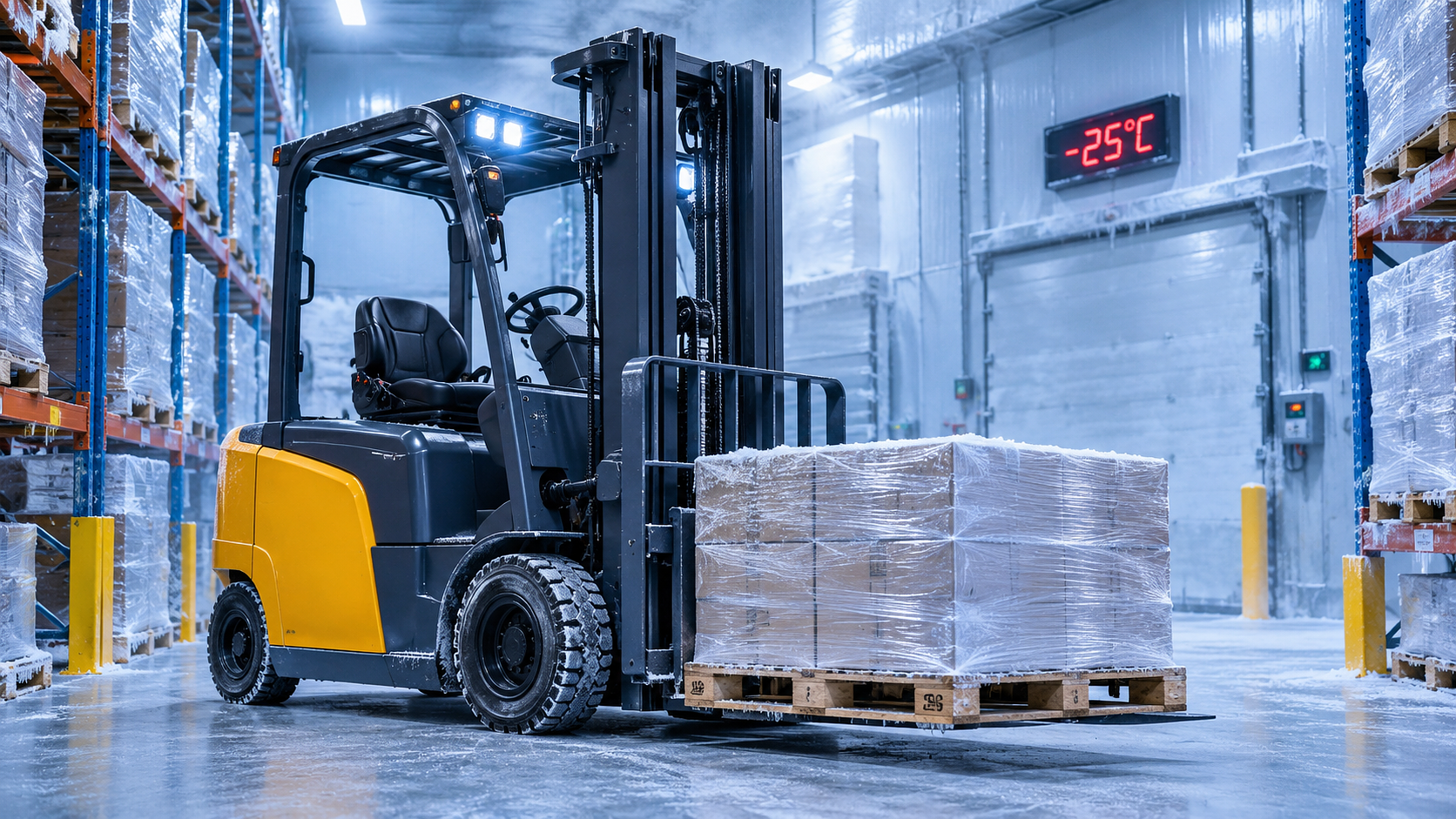
Running electric forklifts and other battery-powered material handling equipment in a -20°C to -30°C freezer is not “business as usual with a cab heater.” Cold storage exposes the gaps between brochure specs and operational reality—especially for 3PLs, food distributors, and cold-chain operators expanding into deep-freeze capacity across the GTA.
The challenge is not just performance. The wrong battery chemistry, charging setup, or warm-to-cold travel pattern can create predictable failure modes that quickly become safety issues and audit problems. Below is a practical, engineering-first breakdown of what actually goes wrong in extreme cold storage environments—and how to avoid the most common compliance traps.
1) Battery Discharge Shock: Why Capacity Drops and Runtime Collapses
In deep cold, the single biggest surprise for operators is how quickly electric trucks feel “underpowered.” This is not imagination—it is battery chemistry.
Lead-acid batteries slow down significantly as temperature drops. Electrochemical reaction rates decrease, internal resistance rises, and usable amp-hour capacity can fall dramatically. In real-world freezer duty, it is common to see 30–50% effective capacity loss compared to room-temperature expectations, depending on battery condition, discharge rate, and exposure time.
Lithium-ion batteries generally hold voltage better under load and can deliver more consistent performance. However, lithium has its own cold constraints: many packs restrict charge current at low temperatures to prevent lithium plating. That matters because a battery that “runs fine” can still become operationally constrained if it cannot accept charge when cold.
Procurement trap: Facilities often size a truck based on a nameplate amp-hour rating or a standard “one battery per shift” assumption. In a -25°C freezer, that assumption can fail immediately, forcing mid-shift battery swaps, unplanned downtime, or risky workarounds.
Practical fix: Size the power system for freezer duty, not dock duty. That usually means one or more of the following:
- Higher usable battery capacity than a room-temperature application would require
- Battery thermal management (heated compartments or insulated enclosures)
- Planned charging strategy (opportunity charging or scheduled battery rotation) that matches the chemistry and temperature limits
(For more on power system longevity, see our detailed guide on why forklift batteries fail early and how poor watering kills equipment.)
2) Charging Failures in Cold: Why “Standard Chargers” Become a Bottleneck
Charging in or near freezer temperatures introduces two separate problems: charging efficiency and charging permission.
Lead-acid in the cold: Charging acceptance drops in low temperatures, charging times extend, and the risk of incomplete recharge rises. Chronic undercharging accelerates sulfation and shortens battery life. Many operations respond by “turning up” charge time without a plan, which increases heat and can create uneven cell behavior.
Lithium-ion in the cold: Most lithium systems rely on a battery management system (BMS) that will limit or block charging when cells are below a safe threshold. If the truck comes out of a -25°C freezer and is plugged in immediately, the charger may not deliver expected current until the pack warms. Without built-in heating, the “fast charge” promise can disappear at the exact time operations need it most.
Compliance and safety trap: Improvised charging areas—extension cords, blocked access, inadequate ventilation, or chargers placed where condensation drips—can create electrical hazards and trigger findings during a Ministry of Labour, Immigration, Training and Skills Development (MLITSD) visit or third-party audit.
Practical fix: Treat charging as part of the freezer system design. Specify:
- Charger and battery pairing validated for low-temperature operation
- A designated charging zone with controlled temperature (even a modestly heated room makes a major difference)
- Clear cable management, protected outlets, and documented procedures for plug-in/plug-out
3) Thermal Shock and Condensation: The Hidden Cause of Shorts, Arcing, and “Mystery” Faults
One of the most expensive and compliance-sensitive failures in cold storage is condensation-related electrical faults.
When a truck moves directly from a -25°C freezer into a 20°C dock, moisture in the warm air rapidly condenses on cold surfaces—exactly like a glass taken out of a freezer. The difference is that the “glass” now includes:
- Contactors and power electronics
- Connectors and wiring harnesses
- Sensors, encoders, and control boards
This can lead to intermittent shorts, arcing at contact points, nuisance fault codes, or complete no-start events. Beyond downtime, electrical arcing and compromised insulation are safety issues and can become a red flag in an audit if there is evidence of repeated electrical events or bypassed safeguards.
Operational trap: High-velocity travel patterns—freezer to dock to freezer—create repeated condensation cycles that shorten component life. If the facility has no transition protocol, it is only a matter of time before faults become routine.
Practical fix: Reduce thermal shock by design and procedure:
- Use an anteroom/transition zone to stage equipment between freezer and ambient areas
- Specify freezer-rated electrical protection and sealed components where available
- Train operators to avoid immediate high-load operation right after temperature transitions
- Implement inspection routines focused on connectors, contactors, and signs of moisture ingress
(When planning how narrow-aisle equipment handles these tight transitions, review our insights on narrow-aisle forklifts, reach trucks, and turret trucks.)
4) Metal Brittle Behavior and Cold-Weather Wear: Not All Components Fail Gracefully
Extreme cold changes the mechanical reality of equipment. Metals can behave more brittle at low temperatures, elastomers stiffen, and tolerances feel “tighter.” Impacts that would be minor in ambient conditions can become cracking events in deep-freeze duty.
Compliance trap: Cold-induced cracking can show up as damaged guards, compromised forks or attachments, and broken handles or steps—issues that can lead to equipment being deemed unsafe or out of service.
Practical fix: Choose freezer-rated trucks and attachments designed for low temperature operation, and tighten the inspection loop. In cold storage, pre-shift checks should emphasize:
- Fork condition, heel wear, and attachment mounting points
- Guarding and operator compartment integrity
- Tires and traction components for hard, cold floors
5) Hydraulic Oil Viscosity: The “Sludge” Problem That Blows Seals
Hydraulic systems are unforgiving in deep cold. Standard hydraulic fluid thickens dramatically, which increases pump load, slows lift/lower response, and can starve critical components of flow. In practice, this shows up as:
- Sluggish mast and auxiliary functions
- Pressure spikes during cold starts
- Seal damage and leaks that appear “suddenly,” often within weeks if the wrong fluid is used
Procurement trap: A facility buys a “good used electric reach truck” and assumes fluids are a maintenance detail. In -30°C duty, the wrong hydraulic package is not a detail—it is a predictable failure.
Practical fix: Confirm freezer-grade hydraulic oil specifications and service history before deployment. Pair the right fluid with warm-up procedures and maintenance intervals aligned to freezer duty cycles.
6) What Auditors and Safety Teams Care About (and What Gets Missed)
Cold storage sites are often well-run and safety-conscious, but equipment issues in the freezer can tempt teams into informal fixes: overriding fault codes, running damaged cables, or delaying critical repairs because “it still moves pallets.” Those decisions create unnecessary exposure.
Common audit pain points in freezer operations:
- Evidence of recurring electrical faults without documented corrective action
- Inadequate charging area controls and cable management
- Missing or inconsistent pre-shift inspection records
- Equipment used outside its temperature rating or without freezer-specific options
Practical fix: Document freezer-rated equipment specifications, establish a transition protocol, and treat condensation-related faults as root-cause events—not “random electronics.”
(For a broader checklist on what inspectors look for first, see our review on the 2026 guide to Ontario forklift compliance and MLITSD readiness.)
How to Specify the Right Freezer-Rated Electric Truck (A Buyer’s Checklist)
If you are sourcing electric forklifts for -20°C to -30°C, prioritize these requirements early—before you compare price or lift capacity:
- Temperature rating that matches the coldest zone and duty cycle (not just “cold storage capable” language)
- Battery strategy (lead-acid vs. lithium-ion) aligned to runtime needs, charge windows, and thermal management
- Condensation mitigation plan (transition zone, sealed components, procedures)
- Hydraulic package verified for freezer viscosity performance
- Serviceability and parts availability for freezer-rated components
Conclusion: Cold Storage Success Is Built on Real-World Engineering, Not Brochure Specs
Extreme cold storage punishes assumptions. Battery discharge shock, condensation shorts, charging constraints, and hydraulic viscosity are not rare events—they are the predictable realities of operating electric forklifts in -20°C to -30°C environments.
Facilities that plan for these realities reduce downtime, extend equipment life, and avoid the kinds of safety and compliance issues that can surface during an MLITSD inspection or customer audit.
If you are planning freezer expansion, evaluating whether to repair aging assets, or replacing equipment ahead of peak season, our analysis on when it's better to replace a forklift instead of repairing it can help protect your bottom line from mounting mechanical debt.
Premier Lift Equipment can help you evaluate the right freezer-rated forklifts and freezer-ready electric inventory—based on how your operation runs in the real world, not in a brochure.
Ready to upgrade your cold-storage or freezer-ready fleet? Premier Lift Equipment helps operators evaluate freezer-rated reach trucks, dockstocker forklifts, and electric counterbalance units based on real-world operating conditions, not brochure numbers.
- Phone: 905-452-8361
- Email: sales@premierliftequipment.com
- Visit Us: 99 West Drive, Building H, Brampton, ON L6T 2J6