
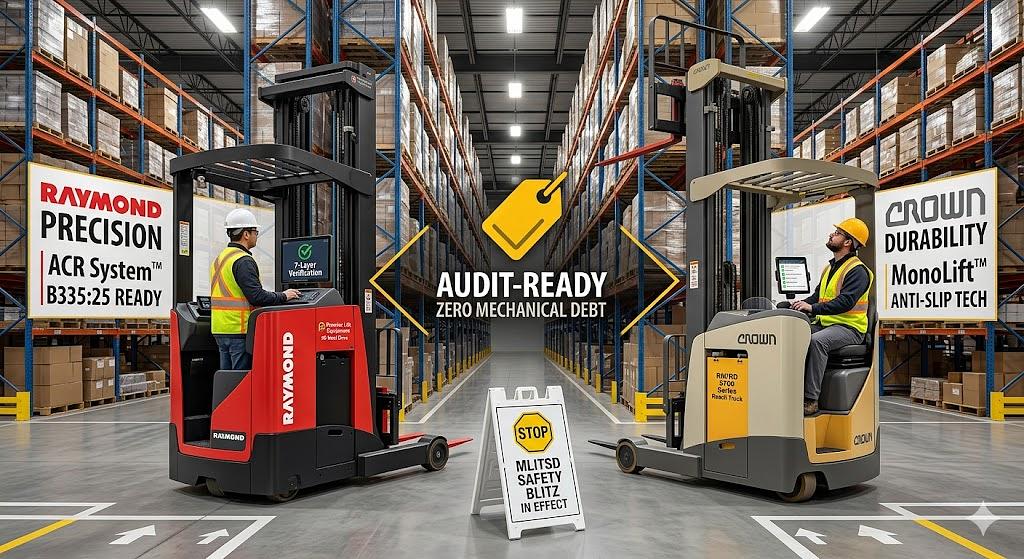
In the high-density warehouses lining the 401 corridor—from Mississauga to Peterborough—the choice between a Raymond Deep Reach and a Crown RM/RD Series isn't just about brand loyalty anymore. As of April 2026, it’s about Compliance Velocity.
With the MLITSD (Ministry of Labour, Immigration, Training and Skills Development) Safety Blitz currently targeting "Struck-by" hazards and ergonomic failures, your choice of reach truck must do more than just lift pallets. it must pass a 2026 audit on day one. As the Ministry shifts its 2026 focus toward MSD (Musculoskeletal Disorder) prevention, the superior ergonomics of Raymond and Crown become your best defense against inspection orders.
The Engineering Duel: Raymond 7000 Series vs. Crown RD 5700
Both manufacturers dominate the GTA for a reason: they are the backbone of high-bay storage. However, they approach the "Mechanical Debt" problem differently.
- Raymond (The Precision Specialist): Known for the ACR System™, Raymond units are often the preferred choice for facilities prioritizing energy efficiency and smooth proportional lift/lower speeds. From an audit perspective, Raymond’s intuitive secondary controls often make operator evaluation easier during a Ministry inspection.
- Crown (The Durability Heavyweight): With the MonoLift™ mast, Crown offers unmatched visibility at height. In the context of the current safety blitz, Crown’s "OnTrac™" anti-slip technology is a significant advantage for warehouses dealing with the spring condensation issues common in Ontario facilities this month.
Beyond the Spec Sheet: The 2026 CSA B335:25 Standard
Whether you choose Raymond or Crown, the "Manufacturer" signal is only half the battle. Your equipment must meet the updated CSA B335:25 standards that we’ve highlighted in our recent 2026 Compliance Pivot report.
At Premier Lift Equipment, we see many "as-is" Raymond and Crown units on the secondary market that carry heavy Mechanical Debt. This debt includes:
- Undocumented Mast Wear: Exceeding the allowable 10% wear on fork thickness.
- Hydraulic Latency: Slow response times that lead to "Struck-by" incidents during high-speed narrow aisle picking.
- Control Drift: Inconsistent steering calibration that fails ergonomic safety checks.
Why "Audit-Ready" Beats "Auction-Direct"
During a trade show week, it’s tempting to look at factory-new lead times or low-cost auction listings. But as we discussed in our guide on Why Buying Direct Beats the Marketplaces, the value is in the verification.
Every Raymond and Crown chassis that enters Building H undergoes our 7-Layer Verification Process. We aren't just checking if it runs; we are ensuring it is "Blitz-Ready." This means the Magnaflux testing is clear, the load backrest is within tolerance, and the battery health is verified to prevent the downtime costs we analyzed in our Hidden Cost of Downtime report.
Need Help Balancing Narrow-Aisle Specs vs. Budget? Comparing reach truck ergonomics and mast performance is critical, but balancing capital cost with tight aisle requirements dictates your ROI. Explore our tiered inventory starting with our Budget Forklifts & Chassis-Only Hub.
The Verdict: Which Fits Your 2026 Strategy?
- Choose Raymond if your facility demands maximum cycles per charge and your operators prefer a multi-function control handle for high-density picking.
- Choose Crown if your warehouse layout requires maximum visibility for operators working at heights exceeding 300 inches, where mast sway is a primary safety concern.
Don't let mechanical debt compromise your facility during the April Safety Blitz. Whether you are leaning toward the precision of Raymond or the visibility of Crown, ensure your next reach truck is an asset, not a liability.
Explore Narrow-Aisle & Certified Reach Truck Categories
If you are upgrading your fleet or looking to match specific narrow-aisle dimensions, Premier Lift can help you determine the correct equipment configuration and supply machinery matching your facility requirements:
- Refurbished Reach Trucks: High-visibility mast options, single and deep-reach configurations.
- Narrow-Aisle & VNA Equipment: Turret trucks, order pickers, and swing-mast units.
Need Help Selecting the Right Forklift?
Our material handling specialists can help identify the correct equipment and narrow-aisle solution for your facility.
✅ Call Our Brampton Team Directly