
The Doorway Problem: How to Choose a Forklift That Fits Under 82–84 Inches Without Losing Lift Height
Most warehouses don’t realize their biggest forklift limitation isn’t capacity, battery size, or mast height — it’s the doorway.
An 82–84 inch doorway quietly eliminates half the market, especially triple‑mast reach trucks and dock equipment that look perfect on paper but physically won’t clear the opening.
If you’ve ever had a unit “almost fit” and scrape the frame, you already know this isn’t a theoretical issue — it’s an operational bottleneck.
Why Lowered Height Matters More Than Mast Type
When buyers compare forklifts, they usually focus on:
- capacity
- lift height
- mast type
- aisle width
- battery size
But in doorway‑restricted facilities, lowered height is the first gate.
If the truck can’t get through the opening, nothing else matters.
A typical triple‑mast reach truck or counterbalance can sit at 85–90 inches lowered.
That’s fine in open docks — but it’s a hard fail in older GTA buildings with 82–84 inch doorways, mezzanine access, or low headers.
2‑Stage Mast (No Free Lift): Lowest Height, Biggest Limitation
A 2‑stage mast without free lift gives you the lowest collapsed height — which is why it’s often the only mast that fits under tight doorways.
But the trade‑offs are real:
- forks rise immediately
- cannot lift inside trailers or under mezzanines
- limited flexibility in tight spaces
- not ideal for mixed warehouse environments
This mast solves doorway clearance but introduces workflow restrictions.
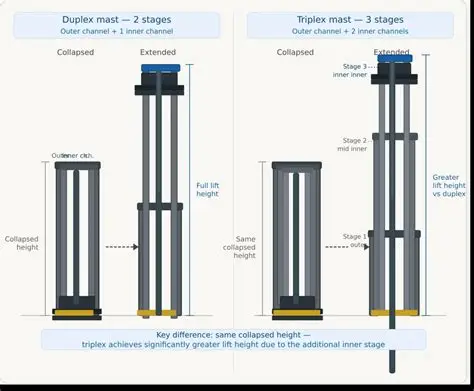
2-Stage vs 3-Stage Forklift Mast: What’s the Difference?
2‑Stage Mast (Full Free Lift): The Ideal Doorway Solution
A 2‑stage mast with full free lift is the sweet spot:
- fits under low doorways
- forks stay down until inner rails rise
- operators can work under mezzanines
- better visibility
- safer in tight aisles
This is the mast type we recommend most often for doorway‑restricted GTA buildings.
Electric Walkie Straddle Stackers | Narrow‑Aisle
3‑Stage Mast: More Height, More Problems
Triple masts offer:
- higher lift
- better racking reach
- more versatility
But they come with two major issues:
- collapsed height is usually too tall for 82–84 inch doorways
- visibility decreases because operators look through more steel sections
This is why so many buyers get stuck renting — the triple mast looks perfect on paper but never fits through the doorway.
Reach Trucks for Sale | Single & Deep‑Reach Forklifts
Quad Mast: Maximum Height, Minimum Visibility
Quad masts are almost never suitable for doorway‑restricted facilities:
- collapsed height is significantly taller
- visibility is the worst of all mast types
- more mast sections = more obstruction
- operators struggle with precision
- not recommended for narrow aisle or low‑header environments
Quad masts are built for high‑bay racking, not older GTA buildings.
VNA Forklifts | Turret & Swing‑Mast | CSA‑Certified
Visibility Challenges Across All Mast Types
As mast sections increase:
- operator sightlines decrease
- forks become harder to place
- pallet entry becomes slower
- safety risks increase
- aisle productivity drops
This is why doorway‑restricted facilities often choose:
- 2‑stage full free lift
- walkie reach
- straddle stackers
These units give operators cleaner visibility and safer maneuvering under low headers.
CSA-Certified Forklift Training | MOL-Approved Certification | Brampton & GTA
Walkie Reach vs Counterbalance Under Low Headers
When you’re fighting doorway height, the choice between walkie reach and counterbalance becomes strategic:
Walkie Reach / Straddle Stackers
- shorter chassis
- lower collapsed height
- mast closer to operator
- ideal for tight doorways
Stand‑Up Counterbalance / Dockstockers
- more versatile
- often taller collapsed
- better for mixed pallet profiles
In older GTA buildings with low interior doorways, walkie reach and straddle stackers win more often — not because they’re “better forklifts,” but because they actually fit.
Stand‑Up Docker Forklifts | CSA‑Certified
How to Calculate True Lowered Height (Without Guessing)
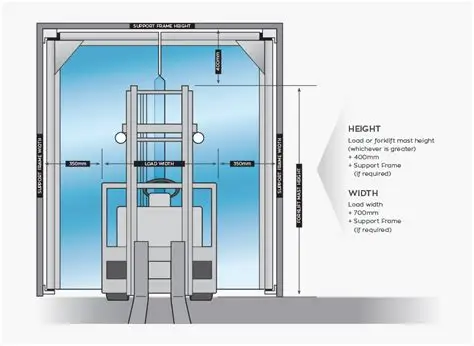
To solve the doorway problem, you need three hard numbers:
- Doorway height
- True lowered height of the mast
- Real operating clearance (1–2 inches minimum)
If your doorway is 84 inches and the truck is 84 inches lowered, it’s not a fit — it’s a problem waiting to happen.
You want 82–83 inches lowered in an 84 inch doorway building.
Compliance & Safety | CSA B335:25 & Audit‑Ready Standards
Real GTA Examples
We see this pattern constantly:
- older industrial units with low interior doors
- mezzanine access with short headers
- converted retail/office spaces turned into micro‑warehouses
- multi‑tenant buildings with inconsistent door heights
On paper, a triple‑mast reach truck looks perfect.
In reality, it never gets through the doorway — and the customer ends up stuck renting a unit that “sort of works” while bleeding cash every month.
What to Ask Before Choosing Your Next Forklift
Before you sign off on any reach truck, walkie, or counterbalance for a doorway‑restricted facility, ask:
- What is my exact doorway height?
- What is the true lowered height of this unit?
- Is there at least 1–2 inches of clearance?
- Is a 2‑stage mast available with full free lift?
- Would a walkie reach or straddle stacker solve the doorway problem better?
- Do I need CSA‑ready equipment that changes mast options?
If you can’t answer these questions, you’re not ready to buy — you’re ready to get stuck.
How Premier Lift Solves the Doorway Problem
We spec units every week for 82–84 inch doorway buildings across the GTA and 401 corridor.
That includes:
- low‑clearance reach trucks
- walkie straddle stackers
- 2‑stage mast solutions
- CSA‑ready equipment
- freezer‑rated options
- narrow aisle solutions
Instead of forcing “exact replacements” that don’t fit, we engineer doorway‑first solutions that:
- clear the opening
- hit the racking height
- match the pallet profile
- protect uptime and operator safety
If you’re staring at an 82–84 inch doorway and wondering what will actually fit, we can run a doorway‑clearance assessment and show you which units will work — and which ones will never make it through the opening.
Contact Premier Lift Equipment | Forklift Sales, Rentals & Service GTA