
Why Some Forklift Batteries Cost More Than the Truck
Published:
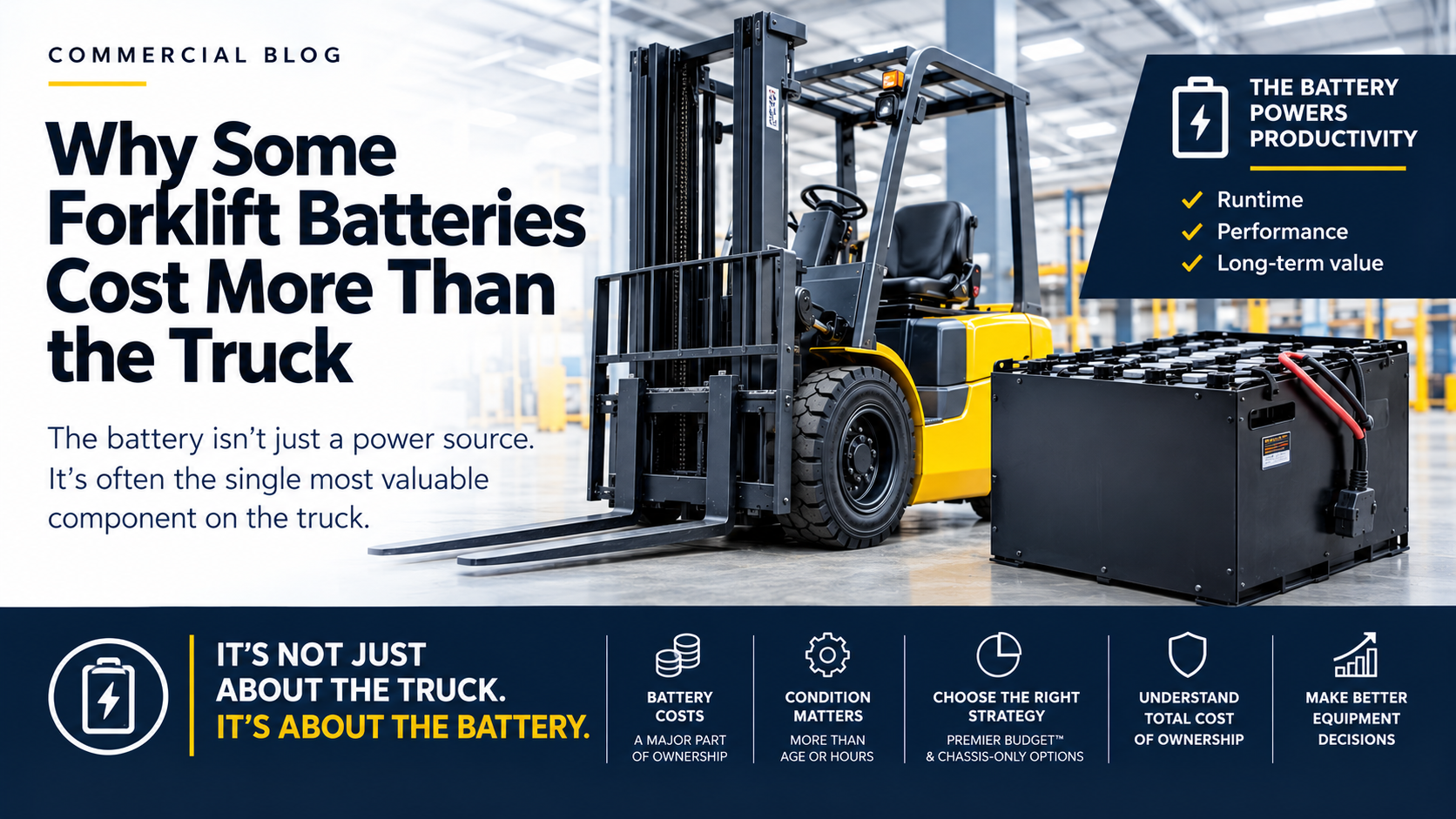
One of the most surprising conversations in the used forklift market happens when a buyer discovers that the battery may be worth more than the forklift itself.
At first, this seems impossible.
How can a battery cost more than a machine weighing thousands of pounds?
The answer is simple: in many electric forklifts, the battery is the single most valuable component on the truck.
Understanding this reality is essential when evaluating used equipment, comparing prices, and determining the true cost of ownership.
The Battery Is the Power Plant
Many buyers naturally focus on the forklift chassis.
They look at:
- age
- hours
- mast height
- lift capacity
- paint condition
While these factors matter, they often overlook the component responsible for making the machine productive.
Without a properly functioning battery, an electric forklift is simply a parked asset.
The battery determines:
- runtime
- productivity
- charging requirements
- replacement planning
- long-term ownership costs
This is why battery condition often has a greater influence on value than equipment age alone.
Why Battery Costs Have Increased
Industrial batteries are not consumer batteries.
They are designed to operate in demanding warehouse and manufacturing environments while delivering consistent power over thousands of charge cycles.
Modern industrial batteries require:
- lead or lithium materials
- specialized manufacturing
- transportation compliance
- recycling programs
- charger compatibility
As a result, replacement costs can be substantial.
In many situations, buyers discover that replacing a battery represents one of the largest ownership expenses associated with an electric forklift.
Why Older Electric Forklifts Still Have Value
Many buyers assume that an older electric forklift automatically represents a poor investment.
The reality is often more complex.
A properly functioning chassis with a clear battery strategy can still provide exceptional value when matched to the right application.
This is especially true for:
- backup equipment
- secondary facilities
- seasonal operations
- lower-utilization environments
- budget-conscious expansion projects
The question should not be:
"How old is the forklift?"
The better question is:
"What will this equipment cost to own over its expected service life?"
Battery Economics Changes Everything
Two forklifts can appear nearly identical while having dramatically different ownership costs.
Common variables include:
- battery age
- battery condition
- charger compatibility
- expected runtime
- replacement planning
- maintenance requirements
This is one reason many buyers review our Battery Economics resources before making a purchasing decision.
Understanding battery economics often explains price differences that initially seem confusing.
Why Chassis-Only Pricing Exists
Battery economics also explains why some equipment is offered using a chassis-only pricing model.
Not every buyer requires the same battery package.
Some operations already own compatible batteries and chargers.
Others prefer to configure power systems independently.
Our Chassis-Only Pricing Framework provides buyers with greater transparency by separating equipment value from battery value, allowing for more informed purchasing decisions.
Instead of forcing every buyer into the same package, the equipment can be evaluated according to operational requirements and ownership objectives.
Understanding the Premier Budget™ Strategy
The Premier Budget™ strategy was developed for buyers who prioritize acquisition cost, capital preservation, and operational flexibility.
Rather than focusing exclusively on age or hours, the Premier Budget™ approach evaluates equipment through the lens of business value.
For many operations, purchasing a proven older forklift while planning strategically for future battery investment can generate a stronger return on investment than purchasing a significantly more expensive alternative.
The objective is not always to purchase the newest forklift.
The objective is to purchase the equipment that best aligns with operational requirements, financial goals, and ownership expectations.
The Real Cost of Ownership
Purchase price is only one part of the ownership equation.
Buyers should also evaluate:
- battery condition
- charger condition
- maintenance requirements
- replacement planning
- expected service life
- downtime exposure
- operational demands
These factors determine whether equipment ultimately becomes a good investment.
Understanding battery economics helps buyers make better decisions and avoid unexpected ownership costs.
Final Thoughts
Many buyers focus on the forklift while overlooking the component that often represents the greatest portion of the investment.
In electric equipment, batteries frequently drive more of the ownership equation than the chassis itself.
Before comparing forklifts by age, appearance, or asking price, evaluate the battery strategy, ownership costs, and expected return on investment.
The battery may be more important than the truck.
FAQ: High-Hour Forklifts
What is considered high hours on a forklift?
There is no universal number that automatically makes a forklift a poor investment. The significance of hours depends on maintenance history, operating conditions, component condition, and the intended application.
Can a high-hour forklift still be reliable?
Yes. Many industrial forklifts continue to operate productively for years when they have been properly maintained, repaired, and matched to the appropriate application.
Is a low-hour forklift always a better purchase?
Not necessarily. Equipment that has been neglected, improperly maintained, or left unused for extended periods can create ownership challenges regardless of the hour meter reading.
What is more important: hours or condition?
Condition is typically the better indicator of value. Buyers should evaluate maintenance history, battery condition, hydraulics, mast condition, tire wear, refurbishment history, and total ownership costs rather than relying on hours alone.
Explore Related Buyer Resources
To learn more about ownership strategies, pricing transparency, and value-focused equipment decisions:
✅ Premier Budget™ Forklifts | Older & Chassis-Only Units
✅ Why Older Forklifts Still Make Sense in 2026
✅ High Hours vs Poor Condition: What Most Buyers Get Wrong
✅ Battery Economics: The Hidden Costs Behind Electric Forklifts
✅ Chassis-Only Pricing: Full Transparency
Whether you're evaluating older electric forklifts, planning battery replacement, or looking to preserve capital, understanding ownership costs will help you make more informed equipment decisions.
Considering a Premier Budget™ Forklift?
Not every operation requires the newest equipment or the largest capital investment. Our team can help you determine whether the Premier Budget™ or Premier Certified™ ownership strategy is the best fit for your application, utilization requirements, and budget.
✅ Call Our Brampton Team Directly