
The Real Difference Between Age, Condition, and Value
Published:
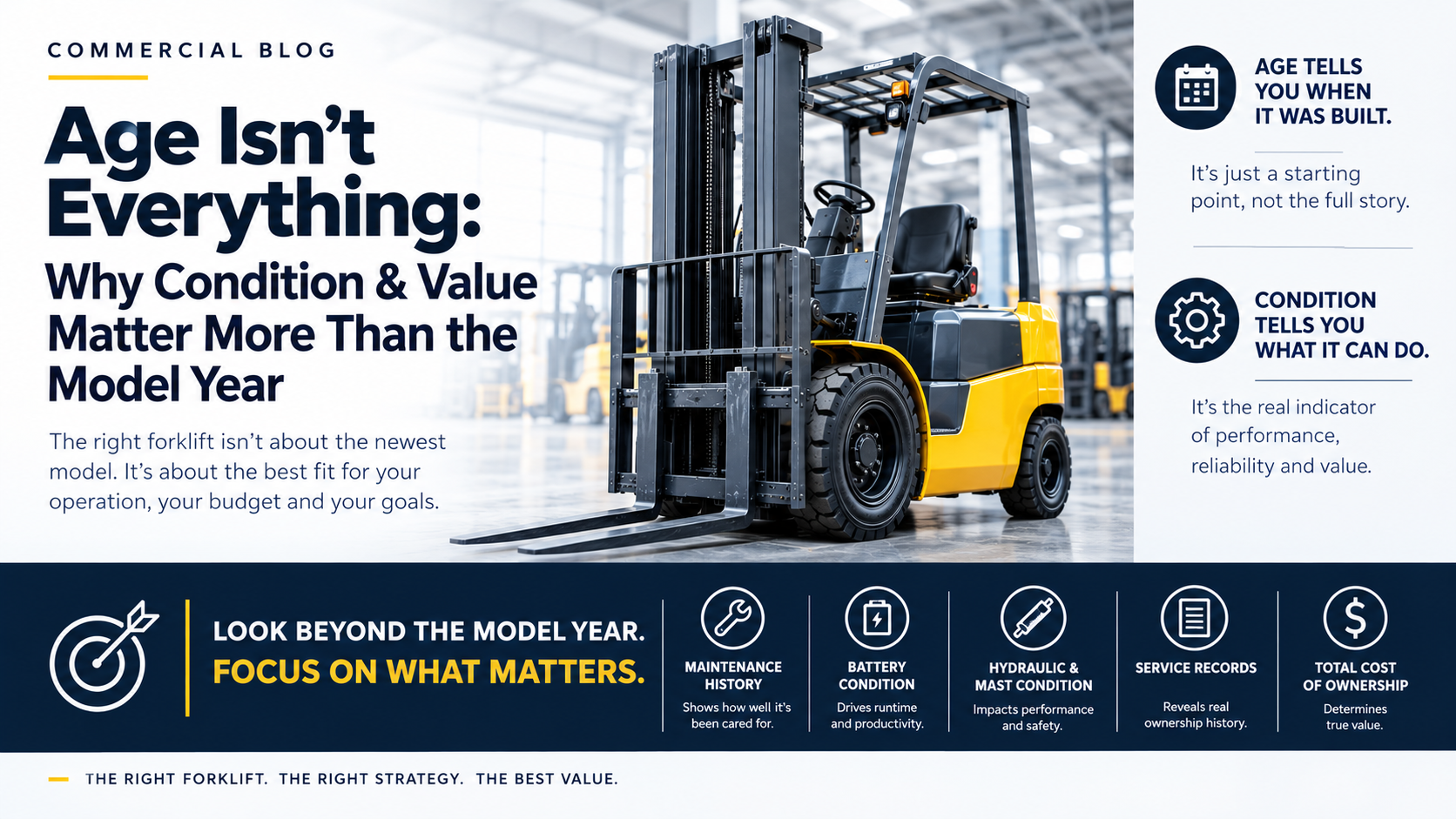
When evaluating used forklifts, many buyers make the same mistake.
They focus on age before they evaluate value.
A forklift's model year is often the first thing buyers notice, but it is rarely the most important factor in determining whether a machine is a good investment.
Industrial equipment should be evaluated based on how it has been used, maintained, repaired, and matched to the intended application.
Age provides context.
Condition determines value.
Why Age Gets Too Much Attention
Age is easy to understand.
A buyer can quickly compare:
- a 5-year-old forklift
- a 10-year-old forklift
- a 15-year-old forklift
and assume the newer unit must be the better purchase.
While that assumption seems logical, it often ignores the factors that actually determine long-term ownership success.
A newer forklift that has been neglected may present far greater ownership costs than an older forklift that has been properly maintained.
Age alone rarely tells the complete story.
Condition Is What Buyers Are Actually Purchasing
When experienced equipment buyers evaluate forklifts, they focus on condition rather than age.
Important factors include:
- maintenance history
- battery condition
- mast condition
- hydraulic performance
- tire wear
- service records
- operational history
- refurbishment quality
These factors often have a larger influence on performance and reliability than a model year listed on a specification sheet.
A well-maintained forklift may continue operating productively long after buyers assume its useful life has ended.
Value Is Different From Price
Another common misconception is that value is determined by purchase price.
Value is determined by the relationship between:
- acquisition cost
- operating expenses
- expected service life
- productivity
- maintenance requirements
- return on investment
The least expensive forklift is not always the best value.
Likewise, the most expensive forklift is not automatically the best investment.
The best value is the equipment that delivers the required performance while supporting the buyer's financial objectives.
Why Ownership Strategy Matters
Different operations have different priorities.
Some buyers prioritize:
- uptime
- compliance
- documentation
- operational confidence
Others prioritize:
- lower acquisition cost
- capital preservation
- flexibility
- return on investment
Neither approach is wrong.
The question is which ownership strategy aligns with the operation's requirements.
This is the foundation of the Premier Budget™ and Premier Certified™ frameworks.
Understanding the Premier Budget™ Strategy
The Premier Budget™ strategy is designed for buyers who place greater emphasis on value, flexibility, and acquisition cost.
Many Premier Budget™ buyers intentionally select older equipment because they understand that age alone does not determine productivity or return on investment.
These buyers focus on:
- intended application
- equipment condition
- expected usage
- ownership costs
- business objectives
Their goal is not necessarily to purchase the newest machine available.
Their goal is to purchase the right machine for the job.
Understanding the Premier Certified™ Strategy
The Premier Certified™ strategy is designed for buyers who place greater emphasis on compliance readiness, operational confidence, documentation, refurbishment standards, and reduced uncertainty.
These operations often value additional preparation, inspection processes, and deployment readiness.
For some facilities, those priorities justify the additional investment.
For others, the Premier Budget™ strategy may represent the better business decision.
The correct answer depends entirely on operational requirements.
Looking Beyond Assumptions
One of the most expensive mistakes equipment buyers make is allowing assumptions to drive purchasing decisions.
Assumptions such as:
- newer is always better
- older is always riskier
- higher price means higher value
- lower hours guarantee reliability
can lead buyers away from equipment that may actually be the best fit.
Successful buyers focus on the complete ownership picture.
Making Better Equipment Decisions
Every forklift should be evaluated based on its condition, operational suitability, ownership costs, and expected return on investment.
Age is only one data point.
Condition tells a much larger story.
Value is ultimately determined by how effectively the equipment supports the operation while aligning with the buyer's financial goals.
The best equipment decision is rarely about age alone.
It is about selecting the ownership strategy that delivers the strongest business outcome.
FAQ: Age, Condition, and Value
Does an older forklift automatically have less value?
No. Value is determined by condition, maintenance history, ownership costs, and application fit rather than age alone.
Is a newer forklift always a better purchase?
Not necessarily. A newer forklift that has been neglected may create more ownership challenges than an older unit that has been properly maintained.
What determines forklift value?
Value is influenced by acquisition cost, condition, expected service life, maintenance requirements, productivity, and total cost of ownership.
What is more important: age or condition?
Condition is generally the better indicator of long-term value because it directly affects reliability, performance, and ownership costs.
Explore Related Buyer Resources
✅ Why Older Forklifts Still Make Sense in 2026
✅ High Hours vs Poor Condition: What Most Buyers Get Wrong
✅ Premier Budget™ Forklifts | Older & Chassis-Only Units
✅ Battery Economics: The Hidden Costs Behind Electric Forklifts
✅ Chassis-Only Pricing: Full Transparency
Need Help Choosing Between Premier Budget™ and Premier Certified™?
Different operations require different ownership strategies. Our team can help you evaluate equipment condition, operational requirements, acquisition costs, and long-term ownership expectations to determine which approach best fits your business.
✅ Speak Directly With Our Team