
Why Smart Forklift Buyers Focus on Total Cost of Ownership, Not Purchase Price
Published:
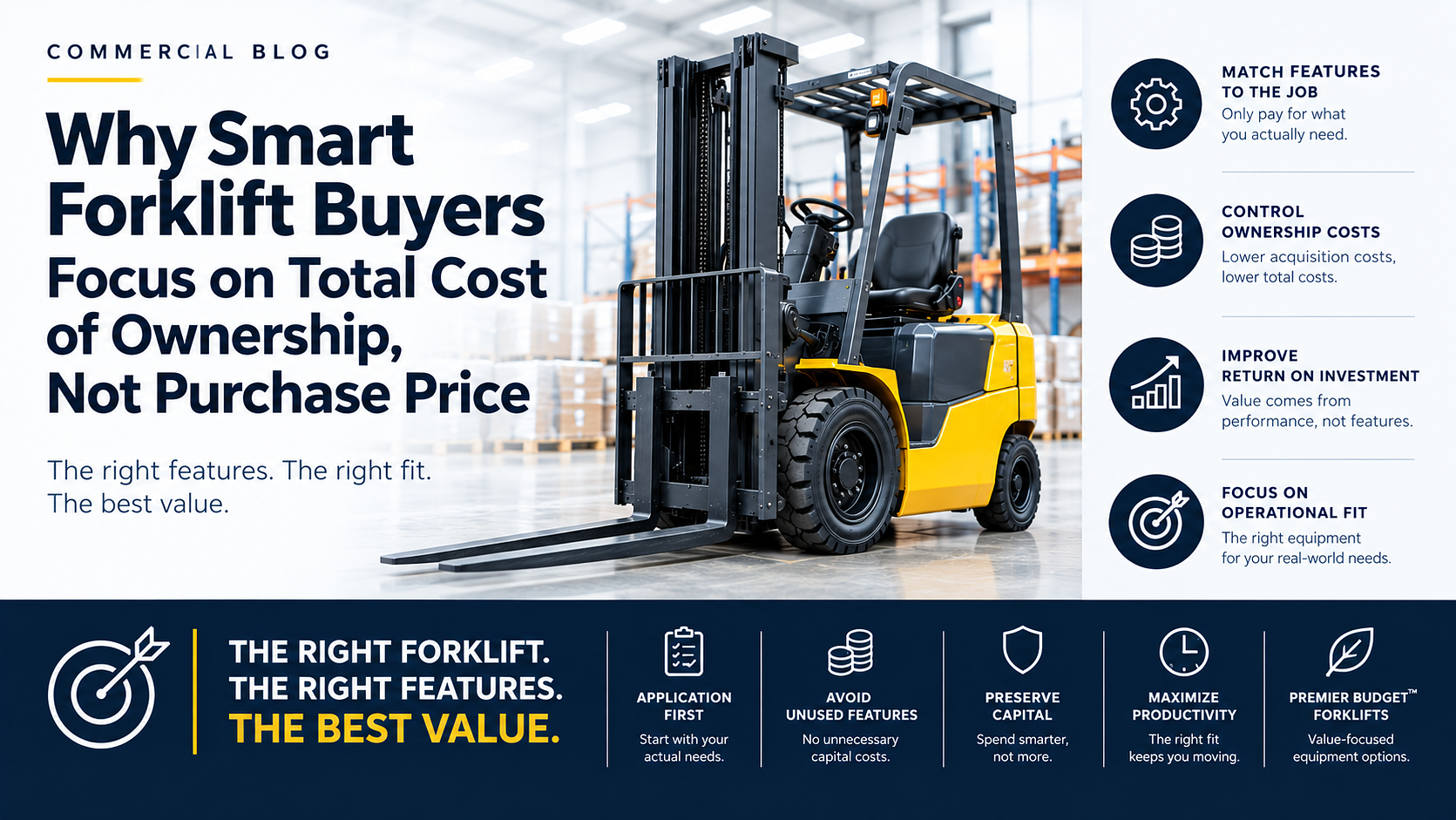
Many forklift buyers assume that more features automatically create more value.
In reality, features only create value when they support the work being performed.
A forklift equipped with advanced options, specialized attachments, upgraded technology packages, or capabilities that are rarely used may increase acquisition costs without improving operational outcomes.
The result is often unnecessary capital expenditure rather than increased productivity.
Successful equipment buyers focus on application requirements first. They evaluate how the forklift will be used, where it will operate, expected utilization levels, load characteristics, lift-height requirements, and overall operational objectives before determining which features are truly necessary.
For some operations, advanced options may provide meaningful productivity improvements.
For others, those same features may deliver little measurable benefit.
This is similar to the assumption that newer equipment automatically creates better value. As discussed in Age Doesn't Determine Value, operational fit often matters more than model year when evaluating equipment investments.
Buying More Than You Need
Many buyers unintentionally purchase capabilities they rarely use.
Examples may include:
- Higher lift capacities than the application requires
- Lift heights that exceed operational needs
- Attachments that see minimal use
- Advanced options that provide limited productivity benefits
- Refurbishment levels that exceed operational requirements
While these features may appear attractive during the purchasing process, they do not automatically improve return on investment.
Value is created when equipment aligns with the actual work being performed.
This same principle helps explain Why Older Forklifts Still Make Sense. Equipment should be evaluated based on operational requirements rather than assumptions about age, appearance, or feature count.
Why Many Businesses Choose the Premier Budget™ Strategy
The Premier Budget™ strategy focuses on matching equipment investments to operational requirements.
For many businesses, the goal is not to purchase the forklift with the most features.
The goal is to purchase equipment that delivers the strongest balance of productivity, operational effectiveness, and financial performance.
Secondary facilities, seasonal operations, backup fleets, and lower-utilization environments often benefit from equipment that performs the required work without the acquisition costs associated with additional features that may never be used.
Businesses evaluating this value-focused ownership approach can explore available Premier Budget™ Forklifts to identify equipment aligned with their operational and financial objectives.
The Better Question
Instead of asking:
"What forklift has the most features?"
Consider asking:
"What features does my operation actually need?"
The answer often leads to a very different purchasing decision.
Many value-focused buyers discover that eliminating unnecessary features helps preserve capital while still maintaining productivity and operational performance.
That same philosophy supports the concepts discussed in Age vs Condition vs Value | Forklift Buying Guide , where equipment investments are evaluated based on business objectives rather than specifications alone.
The strongest equipment investments are not always determined by feature count.
They are determined by how effectively the equipment performs the work it was purchased to perform.
That philosophy remains at the core of the Premier Budget™ ownership strategy.
Explore Premier Budget™ Forklifts and discover value-focused equipment opportunities designed to help preserve capital while supporting operational productivity.
👉 View Premier Budget™ Forklifts
Need Help Determining Which Features Your Operation Actually Needs?
Many forklift buyers invest in features, attachments, or specifications that may never be fully utilized. Our team can help evaluate your application, operating environment, utilization requirements, and budget objectives to identify the equipment that delivers the strongest overall value..
✅ Speak Directly With Our Team