
Explosion-Proof vs. EE-Rated Forklifts: What Ontario Plant Managers Get Wrong During Ministry of Labour Audits
Published:
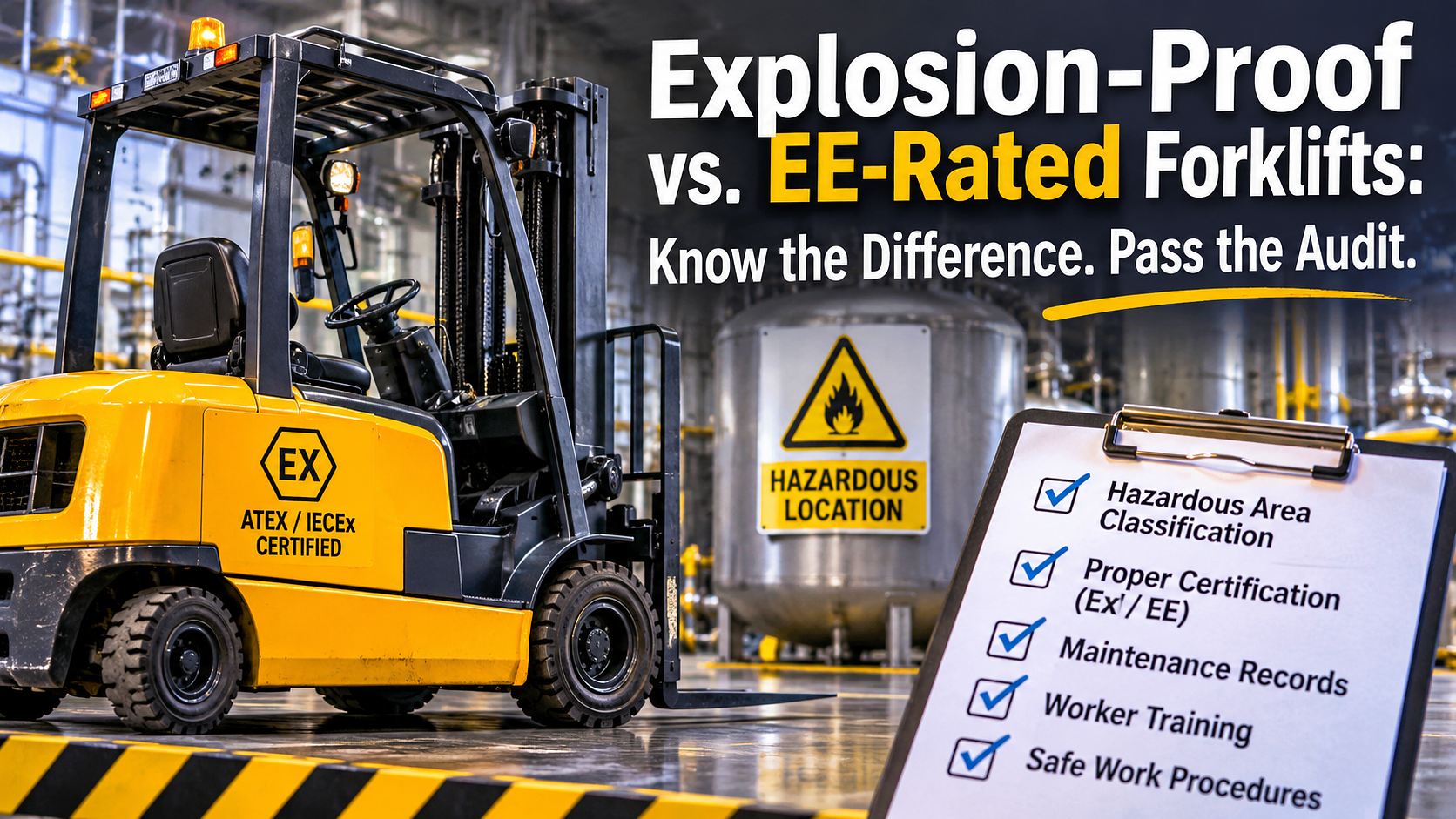
During Ontario Ministry of Labour (MLITSD) audits, few topics create more confusion—and more costly corrective actions—than hazardous-location forklifts. Plant managers often use the terms “explosion-proof forklift” and “EE-rated forklift” interchangeably, assuming that any “spark-resistant” truck is acceptable anywhere flammables or dusts are present. That misunderstanding can trigger orders, equipment shutdowns, and delays in production.
This article clarifies the differences between explosion-proof and EE-rated forklifts, explains what inspectors are typically verifying, and outlines the most common compliance gaps seen in Ontario facilities that handle flammable vapours, combustible dust, or reactive chemicals. For a foundational breakdown of these classifications, check out our guide on Understanding E, ES, EE, and EX Forklift Ratings.
Why This Comes Up in Ontario: Audits Focus on Hazard Controls and Proof
Ontario inspectors are not only looking at the forklift itself. They are assessing whether the employer has correctly identified hazardous locations, selected appropriate equipment, and maintained documentation that demonstrates due diligence. In practical terms, audits often expand from one question—“Is that forklift rated for this area?”—into a broader review of:
- Hazardous area classification (vapours, dusts, fibres; frequency of presence)
- Engineering controls (ventilation, housekeeping, ignition source control)
- Equipment certification/marking and suitability
- Maintenance records and change management (repairs, battery swaps, modifications)
- Worker training and safe operating procedures
In Ontario, workplaces typically anchor hazardous-location decisions to the Canadian Electrical Code (CEC, CSA C22.1) and relevant CSA standards, plus site-specific risk assessments and the requirements under the Occupational Health and Safety Act. Inspectors expect your selections and controls to be defensible, consistent, and documented. For details on preparing your entire operation, review The 2026 Guide to Ontario Forklift Compliance: Is Your Facility MLITSD-Ready?.
Define the Terms: “Explosion-Proof” vs. “EE-Rated” Forklifts
What Plant Managers Often Mean by “Explosion-Proof Forklift”
In many facilities, “explosion-proof” is used as a catch-all phrase for a forklift intended for hazardous environments. However, explosion-proof is a very specific concept in electrical/hazardous-location engineering: equipment designed so an internal ignition will not ignite the surrounding atmosphere, typically through robust enclosures and controlled flame paths (such as EX-rated units).
Forklifts are complex machines with multiple potential ignition sources (electrical systems, motors, static discharge, hot surfaces, friction, brakes). The key compliance point is that a forklift must be properly certified and clearly marked for the specific hazard class/division/zone where it operates.
What “EE-Rated Forklift” Typically Refers To
EE-rated forklifts are commonly understood to be electric trucks with additional safeguards intended for certain hazardous atmospheres—often involving enhanced electrical enclosures and protection to reduce ignition risk. The problem arises when the rating is treated as universal.
An EE rating does not automatically mean the forklift is acceptable in every hazardous location, nor does it replace the need for a formal area classification and verification that the truck’s approval matches that classification. To explore our available inventory designed for these controlled spaces, visit our Refurbished EE-Rated Electric Forklifts Category.
The Core Mistake: Matching a Label to a Hazard Without Doing the Classification
One of the most frequent audit findings is not the absence of a special forklift—it is the absence of a documented hazardous area classification and a clear rationale connecting:
Material Hazards
+
Process Conditions
+
Ventilation/Controls
⟶
Classified Area
⟶
Approved Equipment
Material Hazards+Process Conditions+Ventilation/Controls⟶Classified Area⟶Approved Equipment
Plant teams sometimes rely on informal rules such as “we use the EE truck in the chemical room” or “this is our explosion-proof unit,” without producing the underlying documents. Inspectors will typically expect to see:
- A current hazardous area classification drawing or assessment (including boundaries)
- Identification of applicable classes/divisions or zones per the CEC approach used at the site
- Forklift nameplate/markings that align to that classification
- A procedure controlling where the forklift may and may not operate
What Inspectors Check on the Forklift (and What Gets Missed)
1) Nameplates, Markings, and Third-Party Certification
Audits regularly uncover forklifts that were purchased used, modified, or refurbished without maintaining clear certification markings. A common misconception is that a dealer’s statement or a purchase invoice proves compliance. What inspectors typically want is evidence on the truck and in the file that it is certified/approved for the intended hazardous location.
Practical gap: a forklift may have components that appear “sealed,” yet the overall unit is not marked or documented for the specific hazardous area designation in use at the facility.
2) Modifications and “Equivalent” Parts
Another frequent issue is untracked changes—especially on older trucks:
- Aftermarket lights, strobes, fans, heaters, or power accessories
- Non-original electrical enclosures, connectors, or cable glands
- Battery changes that alter electrical characteristics or introduce charging hazards
Even well-intentioned upgrades can invalidate approvals or create new ignition sources. During an Ontario Ministry of Labour audit, the question becomes: Was the change assessed, approved, and documented?
3) Battery Charging and Hydrogen Control
For electric forklifts, audits often expand to the charging area. Battery charging can introduce hydrogen gas and ignition risks if ventilation and controls are inadequate. A facility may have an EE-rated forklift, but a charging station with poor ventilation, no signage, or inadequate procedures—creating a separate compliance concern. (For more insights on power systems, see our guide on Forklift Batteries & Chargers: How to Choose the Right 24V, 36V, 48V, 80V System).
4) Housekeeping and Combustible Dust Reality
Where combustible dust is present, housekeeping is a leading indicator. Some sites focus heavily on the forklift rating while missing dust accumulation on elevated surfaces, unsealed penetrations, or inadequate cleaning methods. Inspectors may view the forklift selection as only one part of a broader combustible dust control program.
Where Ontario Facilities Commonly Overcorrect (and Still Fail Audits)
Some plants respond to uncertainty by trying to “buy their way out” with the most conservatively described truck available. That can still fail if:
- The hazardous area classification is outdated or undocumented
- The forklift’s rating does not match the site’s class/division/zone
- Operators are not trained on restricted travel zones and material-handling rules
- Maintenance practices are not aligned with the requirements of hazardous-location equipment
In other words, a premium forklift does not replace a compliance system.
A Practical Compliance Approach: How to Be Audit-Ready
Build a Simple “Hazardous Forklift” Documentation Pack
Many Ontario plants reduce audit friction by maintaining a single, easy-to-produce package for each hazardous-location forklift:
- Hazardous area classification drawing/assessment showing where the truck operates
- Forklift identification (make, model, serial number) and photos of nameplates/markings
- Proof of certification/approval documentation from a recognized source and service history
- Change management log for repairs, parts substitutions, and accessory additions
- Operator training records and a site procedure defining approved travel zones
Control the Grey Areas: Borders, Doorways, and “Temporary” Work
Audit issues often surface at boundaries—loading docks, staging areas, drum rooms, spray areas, or entrances to classified rooms. Establish and label boundaries clearly, then define how forklifts may cross them (or not). If “temporary” tasks occur (spill cleanup, shutdown work, seasonal production), document how equipment selection changes during those periods.
Key Takeaway: The Forklift Rating Is Only Defensible When the Hazard Is Defined
The most common Ontario audit failure is not choosing the “wrong” forklift brand or model. It is failing to connect the forklift’s rating—whether described as explosion-proof, EE-rated, or otherwise—to a documented hazardous location classification and a maintained compliance program.
If your facility handles flammable liquids, combustible dust, solvents, or reactive chemicals, the fastest path to audit readiness is to confirm three things: your area classification is current, your forklift markings match the classification, and your maintenance and change management preserve the approval.
When those pieces align, Ministry of Labour audits become far more predictable—and far less disruptive.
Next Steps & Support
- Explore Specialized Inventory: View our current lineup of spark-resistant units on our Refurbished EE-Rated Electric Forklifts Category Page.
- Verify Fleet Compliance: Request professional guidance through our CSA B335 Forklift Inspections & Compliance Services.
- Speak with Our Team: Call us directly at 905-452-8361 to discuss your facility's specific hazard classifications, audit readiness, or custom fleet sourcing requirements.
Disclaimer:The information provided in this article is for general informational and educational purposes only and reflects general principles associated with Ontario Ministry of Labour, Immigration, Training and Skills Development (MLITSD) compliance and CSA B335 standards. Regulations, hazard classifications, and site conditions vary significantly between facilities. Employers and plant managers should consult a qualified safety engineer, certified industrial hygienist, or official regulatory authority to determine specific site classifications and equipment suitability.