
EE‑Rated Electric Forklifts | Hazardous & Controlled Environments
Specifications
| Condition | Refurbished |
| Part ID | EE‑MASTER‑001 |
| Classification | Category Page (Not an Equipment Listing) |
| Capacity Range | 3,000–12,000 lb |
| Mast Range | 80"–400" |
| Power Options | 24V · 36V · 48V · 80V |
| Electrical System | Enclosed motors · Sealed wiring · Spark‑resistant components (EE rating) |
| Compliance | CSA B335 · Hazard‑zone alignment · MOL visibility protocols |
| Subcategory Index | EE‑Rated Electric Forklifts include the following classes: |
| Available EE‑Rated Units (Examples) | Raymond 425‑C40QM – EE Rated – 4,000 lb – Quad Mast Toyota 8FBCU25 – EE Rated – 5,000 lb – 189” Triple Mast Crown RC5545‑40 – EE Rated – Docker – 4,000 lb Jungheinrich ETG350 – EE Rated – 5,000 lb – 240” Quad Mast |
| Hazard‑Zone Compliance | CSA B335 • UL EE • MOL compliant Enclosed electrical system Audit‑ready documentation included |
| EE‑Rated Sit‑Down Counterbalance | Indoor hazard‑zone material handling. |
| EE‑Rated Stand‑Up Counterbalance | Tight‑aisle hazard‑zone operations. |
| EE‑Rated Walkie Counterbalance | Low‑emission handling in controlled environments. |
| EE‑Rated Walkie Straddle Stackers | Clean‑room and food‑grade lifting. |
| EE‑Rated Narrow‑Aisle Units | Hazard‑zone reach and deep‑reach applications. |
| Category Standards & Compliance | EE‑rated forklifts in this category support: • CSA B335 industrial truck requirements • Hazard‑zone and controlled‑environment expectations • MOL visibility and pedestrian‑awareness protocols • Enclosed electrical system requirements (EE rating) • Food‑grade and pharmaceutical cleanliness expectations Units include enclosed motors, sealed wiring, and spark‑resistant components suitable for designated hazard zones. Documentation is available for internal safety |
| Supported Manufacturers | Toyota · Raymond · Crown · Hyster · Yale · Cat · Mitsubishi · UniCarriers · Clark · Komatsu · Hyundai · Hangcha · BYD · Linde · STILL · Doosan · Jungheinrich |
| Representative EE‑Rated Units (CSA‑Ready Examples) | (These are NOT for sale — they are examples that help search engines understand the category.) Example 1 – EE‑Rated Stand‑Up Counterbalance (3,500 lb) 189" triple mast 36V electric Enclosed motors & sealed wiring CSA B335 compliant Ideal for: tight‑aisle hazard‑zone operations Example 2 – EE‑Rated Sit‑Down Counterbalance (5,000 lb) 240" quad mast 48V electric Spark‑resistant components Food‑grade & pharmaceutical alignment Example 3 – EE‑Rated Walkie Counterbalance (4,000 lb) 128" lift 24V system Clean‑room compatible Low‑emission hazard‑zone handling |
| Compatibility & Use Cases | Compatible Environments Hazardous classified areas · Chemical plants · Pharmaceutical facilities · Food‑grade production · Combustible dust operations · Controlled industrial environments Common Use Cases Pallet handling in hazard zones · Production‑line support · Indoor material handling where EE rating is required · Clean, low‑emission operation in sensitive areas |
| Fleet Deployment & Integration | EE‑rated forklifts can be integrated into: Mixed fleets · Hazard‑zone‑specific fleets · Multi‑site operations with standardized safety requirements Programs can include: Hazard‑zone fleet standardization · Battery/charger planning · CSA documentation support · Replacement planning for non‑compliant legacy units |
| Why This Category Matters | EE‑rated forklifts are essential when: • Standard electrics are not permitted • Hazard‑zone compliance is mandatory • Enclosed electrical systems are required • CSA/MOL and internal safety standards must be met They reduce risk, support compliance, and enable safe material handling where ignition sources must be tightly controlled. |
| Who This Category Is For | Chemical processing · Pharmaceutical manufacturing · Food & beverage production · Hazard‑classified warehouses · Controlled industrial environments · Facilities with combustible dust or flammable vapors |
| FAQ: EE‑Rated Electric Forklifts — Safety, Certification & Compliance Guide | Q: What does “EE‑Rated” mean on an electric forklift? A: An EE‑Rated forklift is engineered for hazardous or controlled environments where flammable vapors, fine particulates, or ignition‑sensitive materials may be present. These units include additional electrical enclosures, sealed components, spark‑resistant systems, and enhanced wiring protection to prevent ignition risks. Q: How is an EE‑Rated forklift different from a standard electric forklift? A: Standard electric forklifts are designed for general warehouse use. EE‑Rated forklifts add multiple layers of protection: enclosed motors, sealed contactors, spark‑resistant electrical systems, and reinforced wiring. They are certified for environments where a standard electric unit would not meet safety requirements. Q: Where are EE‑Rated forklifts required? A: They are commonly required in chemical processing, food production, pharmaceutical facilities, cold storage, paint and coatings plants, battery rooms, and any operation with airborne particulates or flammable vapors. Safety managers often specify EE units to meet CSA, UL, or internal compliance standards. Q: Are EE‑Rated forklifts more expensive to maintain? A: They can be slightly more expensive due to specialized components and sealed electrical systems. However, they typically reduce downtime in sensitive environments because they are built to withstand harsher conditions and contamination. Q: Can an EE‑Rated forklift be used in non‑hazardous environments? A: Yes. EE‑Rated forklifts can operate anywhere a standard electric forklift can. Many companies choose them proactively to meet future compliance requirements or to standardize safety across multiple facilities. Q: Do EE‑Rated forklifts require special charging equipment? A: Not usually. Most EE‑Rated forklifts use standard 24V, 36V, or 48V industrial chargers. However, some facilities require chargers to be located in ventilated or designated safe zones depending on their internal safety policies. Q: How do I know if my facility requires an EE‑Rated forklift? A: Your safety manager, CSA inspector, or insurance provider can confirm. If your operation handles chemicals, powders, aerosols, or flammable materials, an EE‑Rated forklift is often mandatory. Q: Are EE‑Rated forklifts slower or less powerful? A: No. Modern EE‑Rated forklifts deliver the same lifting capacity, travel speed, and performance as standard electric units. The difference is in the protective engineering, not the powertrain. Q: What documentation comes with an EE‑Rated forklift? A: Units typically include CSA/UL certification labels, compliance plates, and documentation confirming the electrical system meets EE requirements. Premier Lift Equipment provides full certification packages with every EE‑Rated unit. |
Description
EE-Rated Spark-Resistant Forklifts 2026 | Certified for Hazardous & Refined Environments | CSA/MOL Compliant | Custom Fleet Sourcing.
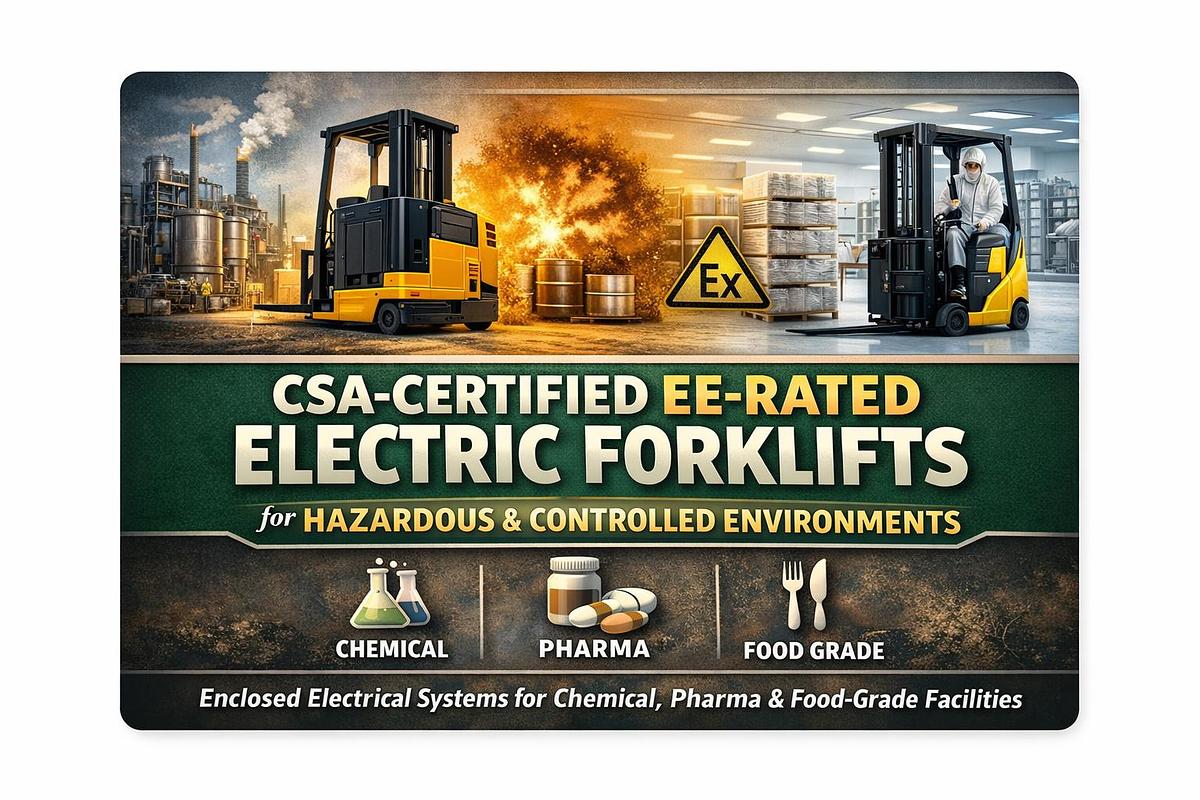
EE‑rated electric forklifts are engineered for hazardous and controlled environments where enclosed electrical systems, sealed wiring, and spark‑resistant components are mandatory. These units meet CSA B335, UL EE, and MOL expectations, providing safe operation in facilities where ignition‑sensitive materials, vapors, or particulates may be present.
Designed for chemical processing, pharmaceutical production, food‑grade manufacturing, and combustible‑dust operations, EE‑rated forklifts deliver the same lifting performance as standard electrics while adding the protective engineering required for hazard‑zone compliance. Capacities range from 3,000–12,000 lb with mast heights up to 400", depending on model and configuration.
Premier Lift Equipment supplies fully inspected, CSA‑ready EE‑rated forklifts across multiple classes with enclosed motors, sealed wiring, and spark‑resistant electrical systems. Documentation packages are available to support internal audits, safety reviews, and facility compliance requirements.
KEY SPECIFICATIONS
• Capacity Range: 3,000–12,000 lb
• Mast Range: 80"–400"
• Power Type: 24V / 36V / 48V / 80V
• Electrical System: Enclosed motors, sealed wiring, spark‑resistant components
• Certification: CSA B335 & hazard‑zone aligned
• Stock Number: EE‑MASTER‑001
EE‑Rated vs Standard Electric Forklifts — What’s the Difference?
EE‑Rated Electric Forklifts
Designed for hazardous or controlled environments, EE units include additional safeguards to prevent ignition from electrical components. These models are engineered for operations where flammable vapours, fine airborne particulates, or sensitive manufacturing processes require elevated protection.
Key Characteristics of EE‑Rated Units:
- Fully enclosed motors, switches, and electrical housings
- Spark‑resistant wiring and component isolation
- Reduced surface temperatures on motors and controllers
- CSA/UL compliance for designated hazard zones
- Required in many food, chemical, pharmaceutical, and high‑dust facilities
Standard Electric Forklifts
Built for general indoor warehouse use, standard electrics offer excellent efficiency and manoeuvrability but do not include the additional containment or spark‑prevention systems found in EE‑rated equipment.
Key Characteristics of Standard Electric Units:
- Open electrical components
- Suitable for non‑hazardous warehouse environments
- Lower acquisition cost
- Ideal for general material handling, distribution, and manufacturing
Which One Do You Need?
Choose EE‑Rated if your facility has:
- Hazardous classifications
- Flammable dust, vapours, or chemicals
- Strict compliance requirements
Choose Standard Electric if your operation is:
- General warehouse or distribution
- Non‑hazardous
- Focused on cost‑efficiency and uptime
IDEAL APPLICATIONS
• Hazardous classified areas
• Chemical processing
• Pharmaceutical production
• Food‑grade manufacturing
• Combustible dust environments
• Controlled industrial environments
RELATED CATEGORIES
- 3‑Wheel Electric Forklifts
- 4‑Wheel Electric Forklifts
- Electric Walkie Counterbalance Forklifts
- Electric Walkie Straddle Stackers
- Warehouse Safety Equipment
- EE‑Rated Narrow‑Aisle Units
Why Premier Lift Equipment for EE‑Rated Forklifts
- CSA‑aligned reconditioning workflow
- Hazard‑zone documentation support
- Battery/charger matching for EE‑rated systems
- Fast delivery across GTA + export‑ready compliance
- Proven deployments in chemical, pharma, and food‑grade facilities
RELATED INSIGHTS & BUYER TOOLS
E, ES, EE & EX Forklift Ratings Explained | Premier Lift
Electric vs Propane Forklifts | Which One Fits Your Future
Forklift Tire Types Explained: Cushion vs Pneumatic
2-Stage vs 3-Stage Forklift Mast: What’s the Difference?
PREMIER LIFT SUPPORT ECOSYSTEM
CSA Certification & Inspection
Forklift Service & Repair
Operator Training
Battery & Charger Packages
Safety Accessories & PPE
Hazard‑Zone Documentation Support
NEXT STEPS
Ask About Hazard‑Zone Compliance
Call 905‑452‑8361
Return Policy: Material‑handling equipment is sold as‑is with no returns accepted.
2026 Operational Compliance & Asset Verification All equipment listed by Premier Lift Equipment is verified for alignment with CSA B335:25 (National Standard of Canada) and MLITSD (Ontario Ministry of Labour) safety requirements. Whether you are operating in a 3PL warehouse, food-grade distribution, or heavy industrial site, this unit is processed through our 25-Point Asset Integrity Audit to ensure it is audit-ready for your next provincial safety blitz.
- Regional Compliance: Documentation provided for Ontario (GTA), broader Canada, and export-ready for US/Caribbean logistics.
- Green-Zone Readiness: Our electric inventory is evaluated for high-cycle efficiency and indoor air quality standards.
- Certified Support: Every listing is backed by our Brampton-based technical team, specializing in forklift certification, fleet maintenance, and long-term ROI strategy.
Equipment Compliance & Quality
All EE‑rated electric forklifts within this master category are supplied in alignment with CSA B335 safety standards, UL EE requirements, and MOL compliance expectations. Documentation packages can include CSA/UL inspection records, hazard‑zone alignment details, and facility‑specific configuration information for controlled indoor environments. Requirements may vary based on lift height, voltage class, electrical‑system configuration, and facility safety protocols. Please confirm compliance and documentation needs with our team before deployment.