
More Features Doesn't Always Create More Value
Published:
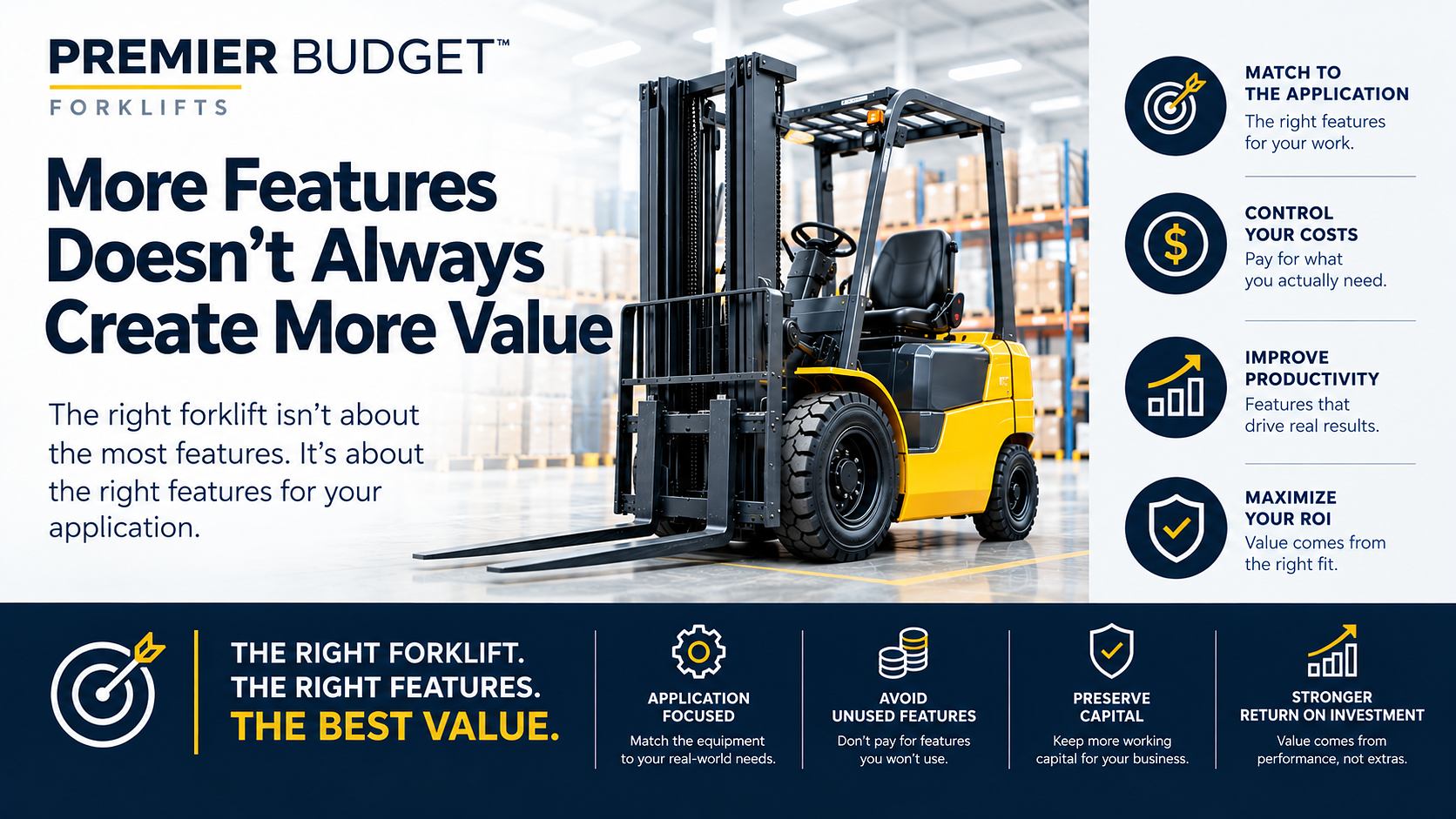
Many forklift buyers assume that more features automatically create more value.
At first glance, that assumption seems reasonable. A forklift equipped with additional technology, specialized attachments, higher capacities, or upgraded options can appear to be a better investment than a simpler machine.
In reality, value is not determined by the number of features a forklift has.
Value is determined by how effectively that equipment supports the work it was purchased to perform.
A forklift that perfectly matches operational requirements often delivers greater value than a more expensive unit loaded with features that may rarely be utilized.
Features Only Create Value When They Solve a Problem
Every additional feature adds cost.
The question buyers should ask is whether that feature creates meaningful operational benefits for their specific application.
For example:
- A higher-capacity forklift may not create value if loads never exceed existing requirements.
- Increased lift height may provide little benefit if storage systems do not require it.
- Advanced attachments can add cost without improving productivity if they are rarely used.
- Additional technology packages may increase acquisition costs without changing day-to-day performance.
Features should be evaluated based on operational necessity, not appearance or perceived advantage.
The most effective equipment investments are often the ones that closely align with actual operating requirements.
This same principle applies when evaluating equipment age. As discussed in The Real Difference Between Age, Condition, and Value, the factors that create long-term value are often very different from the factors buyers focus on first.
Bigger Specifications Do Not Always Produce Better Results
Many buyers focus on specifications because they are easy to compare.
Higher capacities.
Greater lift heights.
More options.
More capabilities.
Yet equipment evaluations are rarely that simple.
The forklift with the longest list of features is not automatically the forklift that delivers the strongest return on investment.
Successful equipment purchases are based on application requirements, operational realities, and expected utilization rather than assumptions about what appears to be the "best" machine on paper.
In many ways, this is similar to how buyers often misinterpret operating hours. As explained in High Hours vs Poor Condition: What Most Forklift Buyers Get Wrong, a single specification rarely tells the complete story.
The Best Equipment Is the Equipment That Fits the Application
Successful buyers typically begin with the application.
They evaluate:
- Product being handled
- Load weights
- Lift heights
- Aisle widths
- Operating environment
- Utilization levels
- Financial objectives
Only after these requirements are understood do features become part of the discussion.
Some operations genuinely benefit from advanced specifications and specialized capabilities.
Others may discover that a simpler forklift delivers the same operational outcome while requiring less capital investment.
This is one reason many older units continue providing excellent value. As explored in Why Older Forklifts Still Make Sense in 2026, equipment effectiveness is often determined by operational fit rather than age or feature count.
More Investment Does Not Automatically Create More Value
Many organizations unintentionally increase acquisition costs by purchasing capabilities they do not require.
The result is often higher upfront investment without a corresponding increase in productivity.
Smart buyers evaluate equipment through the lens of overall ownership value.
That includes acquisition costs, operating costs, expected utilization, maintenance requirements, and operational performance.
This concept is closely related to Why Smart Forklift Buyers Focus on Total Cost of Ownership, Not Purchase Price, where long-term value is measured by the complete ownership experience rather than the initial selling price alone.
Value Comes From Fit
A forklift does not create value because it has more features.
It creates value because it is the right forklift for the work being performed.
The most successful equipment buyers understand that value is created when equipment capabilities align with operational requirements, utilization levels, and business objectives.
Often, the strongest equipment investment is not the newest, most expensive, or most feature-rich option.
It is simply the forklift that best fits the application.
Businesses evaluating value-focused ownership options can explore available Premier Budget™ Forklifts to better understand how equipment selection and financial objectives work together.
Need Help Determining Which Features Your Operation Actually Needs?
Many forklift buyers invest in features, specifications, or attachments that may never be fully utilized. Our team can help evaluate application requirements, utilization levels, acquisition costs, and operational objectives to identify equipment that delivers the strongest overall value for your business.
✅ Speak Directly With Our Team