
The Bridge Strategy: Solving Today's Equipment Problem Without Overcommitting To Tomorrow
Published:
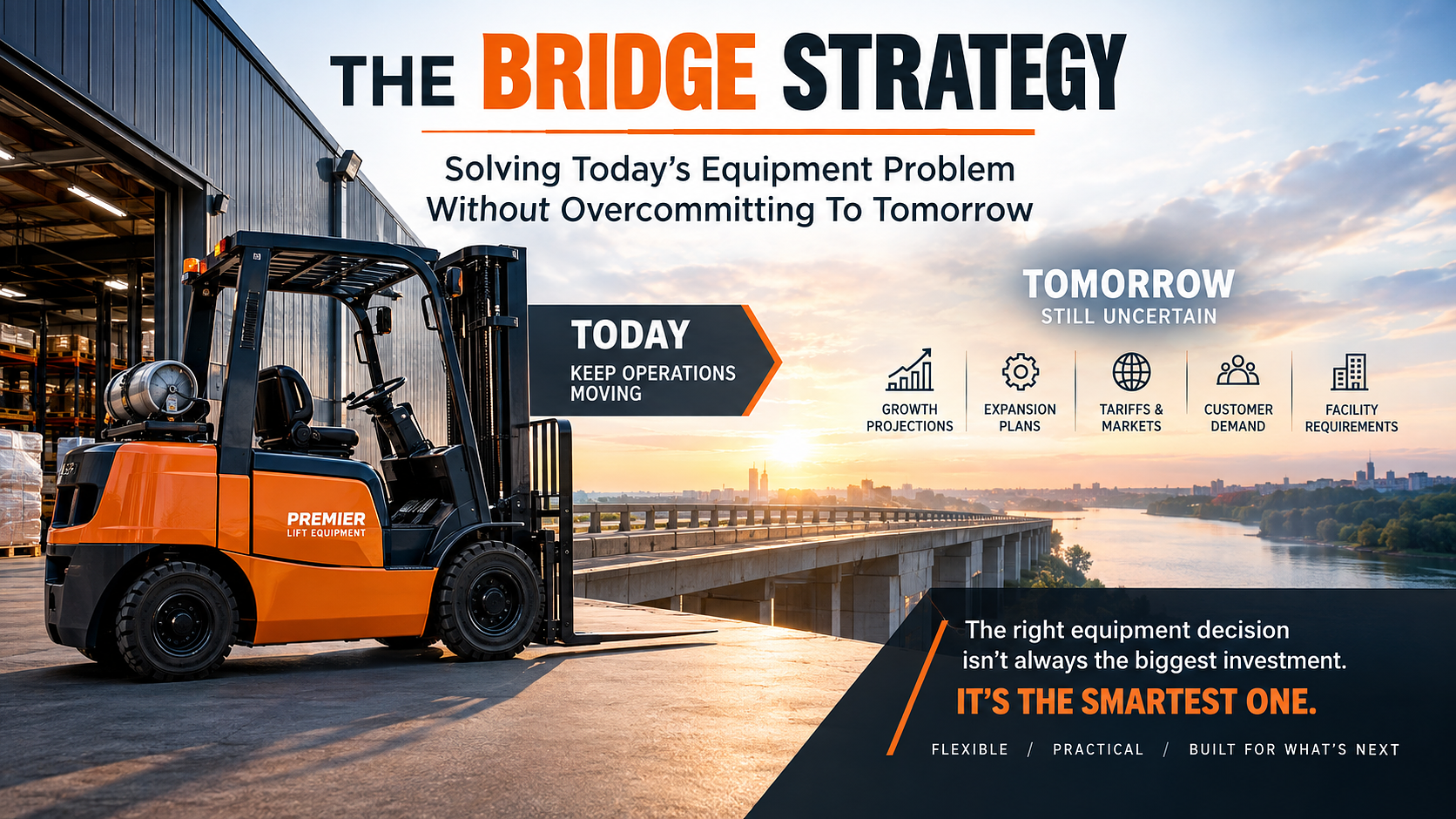
Every business operates in two realities at the same time.
The first reality is immediate.
A forklift fails. Production falls behind. Orders still ship. Operators still need equipment. Customers still expect delivery.
The second reality is uncertain.
Growth projections change. Expansion plans evolve. Tariffs fluctuate. Markets shift. Customer demand rises and falls. Future facility requirements may look very different 12 to 24 months from now.
The challenge facing many businesses is simple:
How do you solve today's operational problem without overcommitting to tomorrow's assumptions?
This is what we call the Bridge Strategy.
The Mistake Many Businesses Make
When equipment fails unexpectedly, many organizations assume they must immediately make the largest possible long-term investment.
That often creates a false choice:
- Delay the decision and accept downtime
- Make a major capital purchase immediately
In reality, there are often more options available.
The smartest decision is not always the largest investment.
Sometimes the smartest decision is purchasing time, preserving flexibility, and maintaining operational continuity while future conditions become clearer.
Today's Problem Is Real. Tomorrow Is Still Being Written.
Consider a typical warehouse operation.
A truck reaches the end of its useful life.
Management may know they need a forklift today.
What they may not know is:
- Whether growth projections will materialize
- Whether a major customer contract will renew
- Whether facility expansion is six months away or three years away
- Whether automation plans will change equipment requirements
- Whether future capital expenditures will become a higher priority
The forklift problem is immediate.
The future remains uncertain.
A rational business strategy recognizes the difference.
Why Flexibility Has Value
In uncertain business environments, flexibility becomes an asset.
Preserving flexibility can mean:
- Maintaining cash reserves
- Protecting working capital
- Reducing commitment risk
- Adjusting fleet strategies later with better information
- Preserving borrowing capacity for future opportunities
This does not mean avoiding investment.
It means aligning investment decisions with the level of certainty available today.
As discussed in our article on Smart Ways to Finance a Forklift Even in Uncertain Times, the strongest equipment decisions often balance operational requirements with financial flexibility rather than focusing exclusively on purchase price.
The Cost Of Waiting Can Be Greater Than The Cost Of Acting
Many businesses delay action while waiting for certainty.
Unfortunately, operations rarely wait.
A failed forklift can create:
- Shipping delays
- Production disruptions
- Overtime costs
- Idle labour
- Customer service challenges
- Reduced warehouse productivity
The hidden cost of doing nothing is often greater than expected.
The concept is similar to what we discussed in The Cost of Mechanical Debt: Why Your Idle Forklift Is a Liability, Not a Saving.
A truck that cannot perform useful work creates operational drag while problems continue to accumulate.
Replace The Problem, Not Necessarily The Fleet
One of the most common mistakes in equipment planning is allowing a single equipment issue to trigger a much larger spending decision.
If one truck fails, the solution may simply be replacing that truck.
Not replacing the entire fleet.
Not redesigning the operation.
Not assuming future needs that may never materialize.
The goal is resolving today's operational bottleneck while preserving the ability to make smarter long-term decisions later.
This is also why understanding When It's Better to Replace a Forklift Instead of Repairing It can be an important factor in protecting long-term fleet economics.
Why Age Alone Tells You Very Little
A common misconception is that newer equipment automatically creates more value.
Experienced operators know that isn't always true.
Condition matters.
Maintenance history matters.
Application matters.
Verification matters.
Our articles:
- High Hours vs Poor Condition: What Most Forklift Buyers Get Wrong
- The Real Difference Between Age, Condition and Value
- Why Older Forklifts Still Make Sense in 2026
all reinforce the same reality:
Equipment should be evaluated based on condition, suitability, and operational value, not simply model year.
Total Cost Of Ownership Matters More Than Purchase Price
Many buyers focus on acquisition cost while overlooking operational costs.
Smart operators typically evaluate:
- Maintenance requirements
- Parts availability
- Battery replacement costs
- Service support
- Productivity impacts
- Lifecycle costs
This is why we encourage buyers to review:
- Why Smart Forklift Buyers Focus on Total Cost of Ownership, Not Purchase Price
- Battery Economics: Runtime, Charger Matching & Total Cost of Ownership
- Canada's 2026 Forklift Pricing Index
A lower purchase price does not automatically create value.
A higher purchase price does not automatically create value.
The right decision is the one that supports the operation while controlling long-term ownership costs.
Not Every Situation Requires Maximum Commitment
Some businesses choose:
- Rentals
- Leasing
- Refurbished equipment
- Certified equipment
- Budget equipment
- Fleet extensions
Each option serves a different purpose.
The decision should reflect the business environment, operational needs, and confidence level about future requirements.
For organizations facing temporary uncertainty, Forklift Equipment Rentals can provide immediate operational capacity without long-term commitment.
For others, ownership may still make the most sense, provided the investment level matches current realities.
The Premier Budget™ Philosophy
Premier Budget™ was never designed around the idea of buying the cheapest forklift available.
It was built around a different question:
What if the smartest decision right now is preserving optionality?
Premier Budget™ inventory is intended for organizations that want to:
- Keep operations moving
- Solve immediate equipment shortages
- Preserve capital
- Reduce commitment risk
- Maintain flexibility for future decisions
For many buyers, Premier Budget™ is not the final destination.
It is the bridge.
A practical solution that allows businesses to continue operating efficiently while larger strategic decisions become clearer.
Explore the Premier Budget™ inventory collection to learn more about this approach.
Flexibility Still Requires Standards
Flexibility should never mean guesswork.
Every equipment decision should be supported by reliable information and clear expectations.
That's why we continue investing in:
- The Forklift Buying Standard
- The Verified Data & Specification Integrity Framework
- Premier's 7-Layer Verification Model
- Equipment Quality Assurance & Universal Warranty Standards
A strategic decision only works when it's based on accurate information.
Confidence comes from transparency.
Not assumptions.
Better Decisions Tomorrow Start With Better Decisions Today
The future will eventually become clearer.
Growth plans will solidify.
Market conditions will change.
Expansion projects will either happen or they won't.
But operations still have to function today.
The strongest operators understand that every decision does not need to solve the next ten years.
Sometimes it only needs to solve the next six months while preserving the freedom to make better decisions later.
That is the essence of the Bridge Strategy.
Not delaying decisions.
Not forcing decisions.
Making decisions that fit reality.
Ready To Build Your Bridge?
If you're facing equipment downtime, uncertain growth projections, rising replacement costs, or pressure to preserve capital, let's discuss the options that make sense for your operation today.
Whether you need:
- Premier Budget™ equipment
- Certified refurbished forklifts
- Rental solutions
- Trade-in programs
- Fleet replacement guidance
- Independent buying advice
our team can help you evaluate the most practical path forward.
Solve today's problem. Preserve tomorrow's options.