
What Forklift Do You Need for 22-Foot, 25-Foot, and 30-Foot Warehouse Racking?
Published:
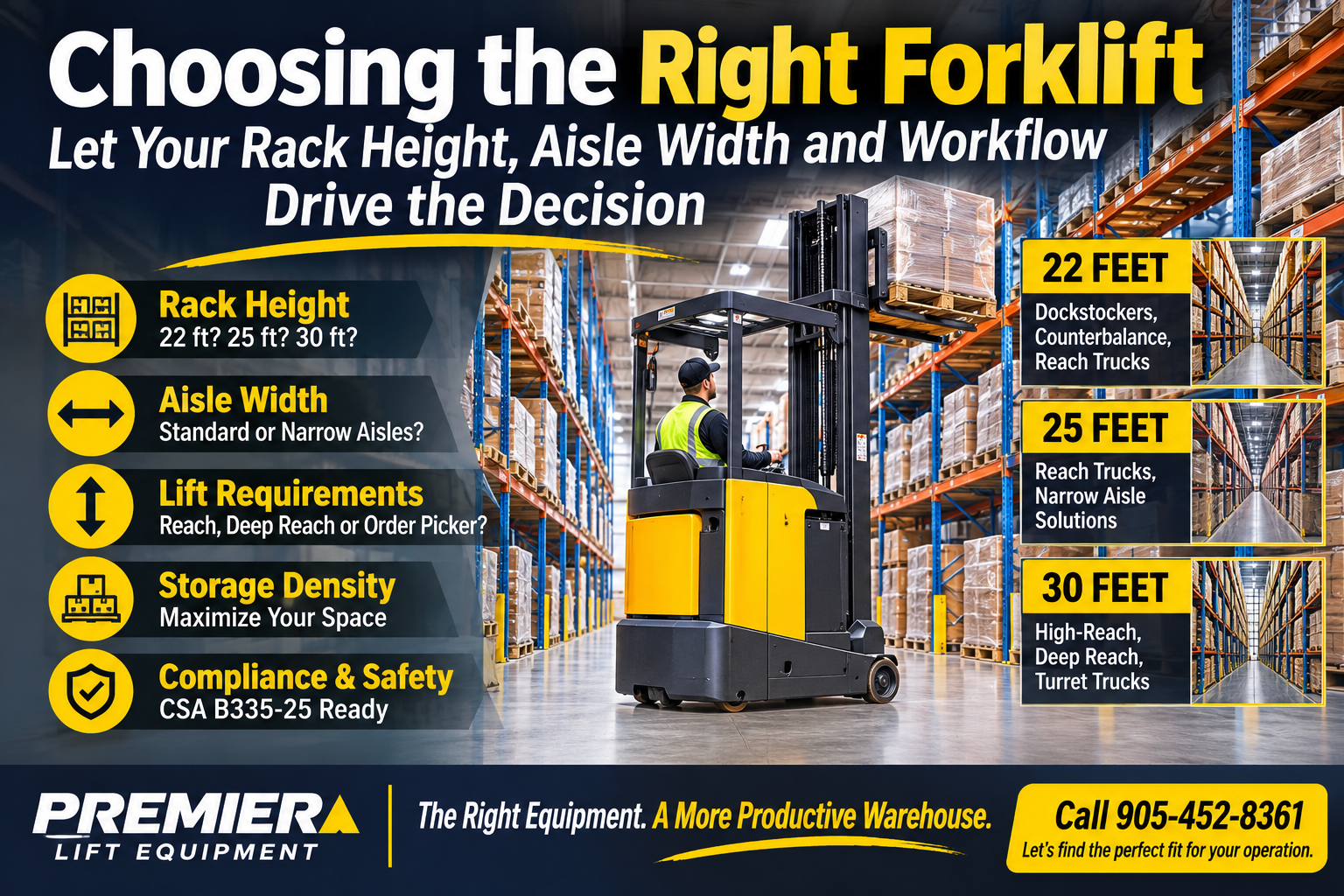
How to Choose a Forklift Based on Your Warehouse Layout (Rack Height, Aisle Width & Door Clearance)
One of the most common mistakes warehouse operators make is choosing a forklift based on price, brand, or available inventory before determining whether the truck can efficiently work within their rack layout.
In reality, your racking height, aisle width, lift requirements, and storage density goals should drive equipment selection long before you compare manufacturers.
A truck that performs well in a 22-foot warehouse may become inefficient or unsafe in a 30-foot operation. The wrong mast configuration can reduce available lift height, while the wrong truck type can waste valuable floor space and force future warehouse expansion.
If you're planning a warehouse layout, adding racking, replacing equipment, or evaluating a facility expansion, here's how to determine what forklift makes sense for your operation.
Start With The Rack Height
Start With The Rack Height & Overhead Clearance
Most warehouse operators focus entirely on overall rack height. The more important question is: What height must the forklift actually lift to place and retrieve pallets safely?
A 22-foot rack system typically requires different equipment than a 30-foot system because lift height, residual capacity, visibility, and stability all become more important as elevation increases.
The Clearance Rule to Remember: When selecting a forklift for a specific tier, you must always account for the top beam height elevation and add an extra 6 to 8 inches (up to 10 inches for high-reach applications) to your minimum mast specification...
If you're still determining capacity requirements, review our guide on How to Choose the Right Forklift Capacity. You should also understand mast configurations before selecting equipment by reading 3-Stage vs 2-Stage Mast: What's the Difference?.
Forklifts For 22-Foot Racking
A warehouse with rack heights around 22 feet often has the widest variety of equipment options available, including stand-up dockstockers, electric counterbalance forklifts, narrow aisle reach trucks, and select order pickers.
- Moderate Density / Conventional Aisles: A dockstocker is often sufficient. Learn more in our comparison: Dockstocker vs Counterbalance: Which One Fits Your Warehouse Layout?.
- High Density: If storage density is a priority, a reach truck frequently generates more pallet positions within the same building footprint.
Forklifts For 25-Foot Racking
Twenty-five-foot rack systems are often where traditional counterbalance equipment begins losing efficiency. At this height, many 3PL facilities, distribution centers, manufacturing warehouses, and e-commerce operations move toward single reach trucks and narrow aisle electric forklifts.
- Learn more in our How to Choose the Right Forklift for a Warehouse guide.
- For e-commerce fulfillment operations, view our Electric Reach Trucks for E-Commerce Fulfillment Centers.
- For 3PL facilities, explore our 3PL Warehousing Forklift Solutions.
Forklifts For 30-Foot Racking
Once warehouse racking reaches 30 feet, equipment selection becomes significantly more specialized, utilizing high-reach single reach trucks, deep reach trucks, turret trucks, order pickers, and very narrow aisle (VNA) equipment.
Operations frequently discover they can increase pallet positions without expanding their building footprint by utilizing reach trucks and narrow aisle equipment effectively.
- See our real-world case study: How To Increase Pallet Positions By 40% In The 401 Corridor.
- Read market trends in Why Reach Trucks Are Breaking Out In 2026.
Aisle Width Matters As Much As Rack Height
A 25-foot rack system with wide aisles may operate perfectly with equipment that would perform poorly inside a narrow aisle environment. Before selecting equipment, understand the differences between reach trucks, deep reach trucks, turret trucks, and order pickers outlined in our Narrow Aisle Forklifts Guide.
Don't Forget Door Height Restrictions
Another common mistake is selecting a forklift capable of reaching the top rack level without verifying building access points—discovering too late that the truck fits the racking but cannot pass through warehouse doors.
Read our breakdown on The Doorway Problem: How To Choose A Forklift That Fits Under 82–84 Inches Without Losing Lift Height.
Compliance and Industry Considerations
Warehouse selection isn't just about lift height—your operating environment and industry matter immensely.
- Hazardous & Regulated Areas: If your facility handles sensitive materials, review Understanding E, ES, EE and EX Forklift Ratings and our CSA B335-25 Audit Ready Equipment Listings.
- Food & Beverage Distribution: Explore our Food & Beverage Distribution Forklift Solutions.
- Manufacturing Facilities: Explore our Manufacturing Forklift Solutions.
- Cold Storage Operations: Explore our Cold Storage Forklift Solutions.
Should You Buy Certified Or Budget Equipment?
The correct forklift type is only half the decision. The other half is determining the ownership strategy that fits your operation, looking beyond basic age and hours to focus on condition, inspection history, and total cost of ownership.
- The Real Difference Between Age, Condition & Value
- High Hours vs Poor Condition
- Why Smart Forklift Buyers Focus On Total Cost Of Ownership
- Premier Budget™ vs Premier Certified™: Which Ownership Strategy Fits Your Operation?
- The Bridge Strategy™: Solving Today's Equipment Problem Without Overcommitting
Ready to Optimize Your Warehouse Layout?
Choosing the right forklift isn't just about matching manufacturer specs—it's about engineering your vertical space, aisle widths, and door clearances for maximum efficiency.
Whether you are mapping out a new 30-foot rack layout, replacing narrow-aisle equipment, or balancing capital costs with compliance, our material handling specialists at Premier Lift Equipment are here to help you evaluate your floor dynamics.
- Call Direct: Speak with our Brampton technical center at 905-452-8361
- Explore Inventory: View our fully inspected, CSA-compliant electric forklifts, reach trucks, and turret trucks ready for GTA-wide deployment.
- Get Guidance: Contact our team today to discuss your facility's specific lift height and layout requirements.